
During a few days in the lovely month of May, Dijon spoke every language of jazz. In the corridors of the conservatory, around round tables, inside festival cafés and even across the cobblestones of the Palace of the Dukes, one encountered Albanian, Serbian, Montenegrin, Macedonian and French musicians… but above all an abundance of smiles, mixed accents and ideas constantly in motion.
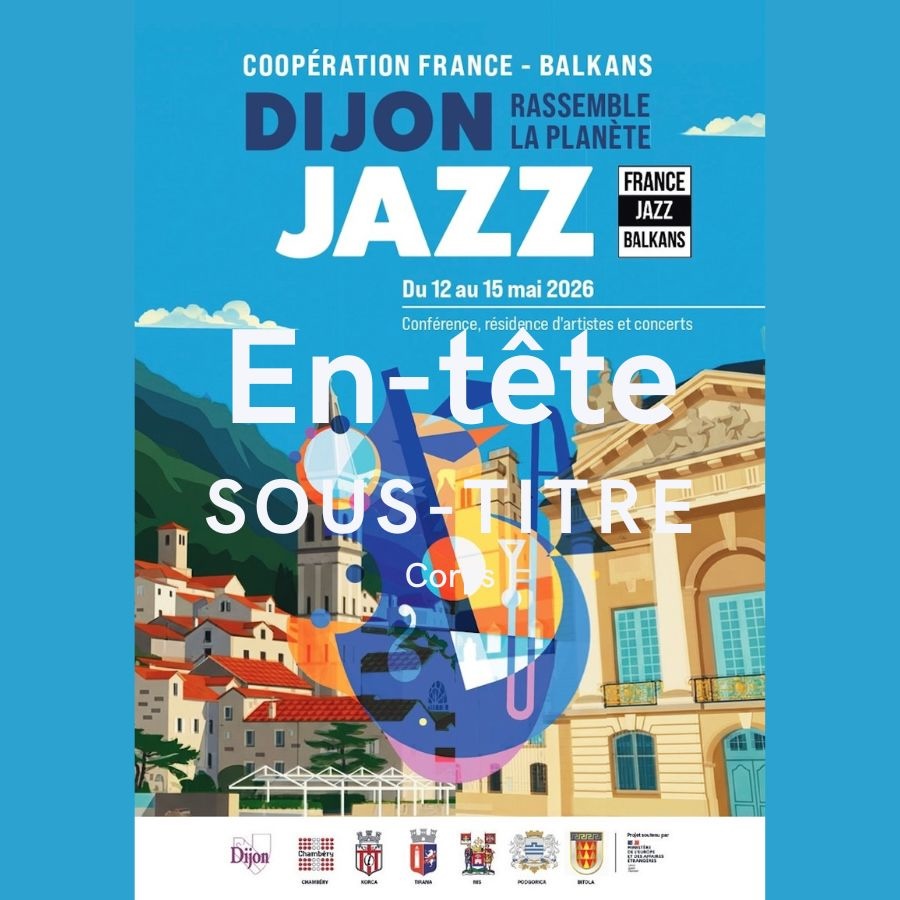
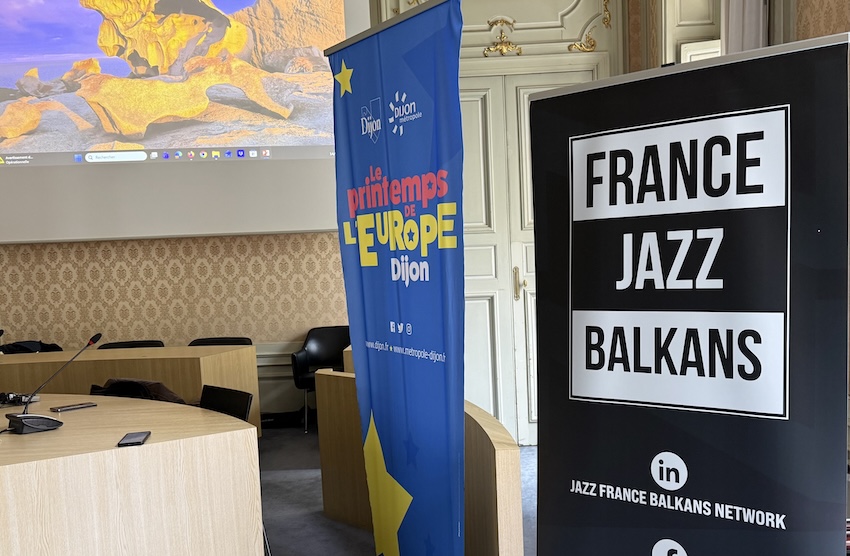
On May 14 and 15, the Burgundian capital hosted the sixth gathering of the Jazz France Balkans Network, a project born in 2019 from a simple conviction: jazz remains one of the finest ways for territories and cultures to speak to one another. Since its beginnings, the network has connected Dijon and Chambéry, representing France, with Tirana, Korçë, Bitola, Niš and Podgorica around a shared rhythm: contemporary music and cultural exchange.
And this year in Dijon, that collective score acquired a particularly vibrant flavour.
During a few days in the lovely month of May, Dijon spoke every language of jazz. In the corridors of the conservatory, around round tables, inside festival cafés and even across the cobblestones of the Palace of the Dukes, one encountered Albanian, Serbian, Montenegrin, Macedonian and French musicians… but above all an abundance of smiles, mixed accents and ideas constantly in motion.
On May 14 and 15, the Burgundian capital hosted the sixth gathering of the Jazz France Balkans Network, a project born in 2019 from a simple conviction: jazz remains one of the finest ways for territories and cultures to speak to one another. Since its beginnings, the network has connected Dijon and Chambéry, representing France, with Tirana, Korçë, Bitola, Niš and Podgorica around a shared rhythm: contemporary music and cultural exchange.
And this year in Dijon, that collective score acquired a particularly vibrant flavour.
Because here, cultural cooperation is not simply discussed through administrative files and plastic conference badges. The network primarily brings together people working directly in the field: musicians, teachers, journalists, programmers, festival directors, cultural officers and international relations representatives from the partner municipalities. People who live jazz on a daily basis and know that a good conversation after a concert can sometimes produce as much as an entire seminar. All this under the guidance of municipalities genuinely invested in the project, with Dijon leading the way.
For two days, the round tables set the tone. And unlike certain conferences where people discreetly glance at their watches after fifteen minutes, the discussions here felt alive, occasionally passionate, often funny, but always deeply human. Listening, so central to jazz itself, became the treble clef guiding every dialogue, meeting and debate.
The first major discussion focused on “Jazz as a Factor for Peace.”
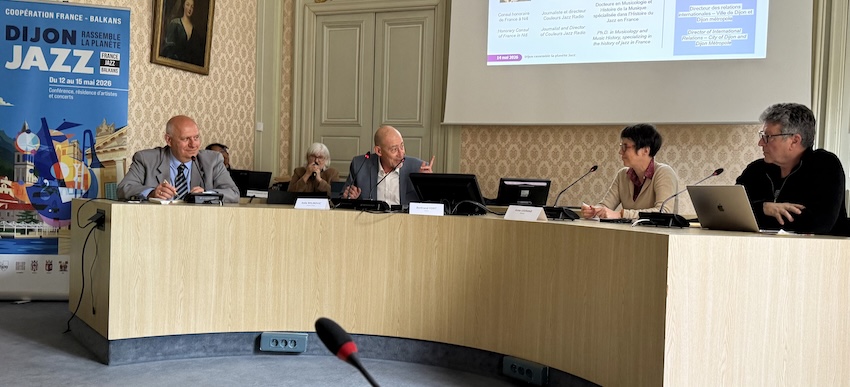
An ambitious, almost dizzying subject in a region marked by a complex history. Yet far removed from abstract slogans, the speakers addressed concrete realities: the ways musicians travel, collaborate and meet despite borders, memories and political tensions. Jazz emerged less as a naïve symbol of universal brotherhood than as a very real practice of dialogue. On stage, the perspectives of Saša Miljković representing Niš in Serbia, jazz historian and musicologist Anne Legrand, and Greek-French pianist and composer Stéphane Tsapis, who was unexpectedly replaced for family reasons by yours truly, under the guidance of maestro Bertrand Fort, Director of International Relations for Dijon, all ultimately pointed toward the same truth: improvising together already requires a rare form of mutual listening.
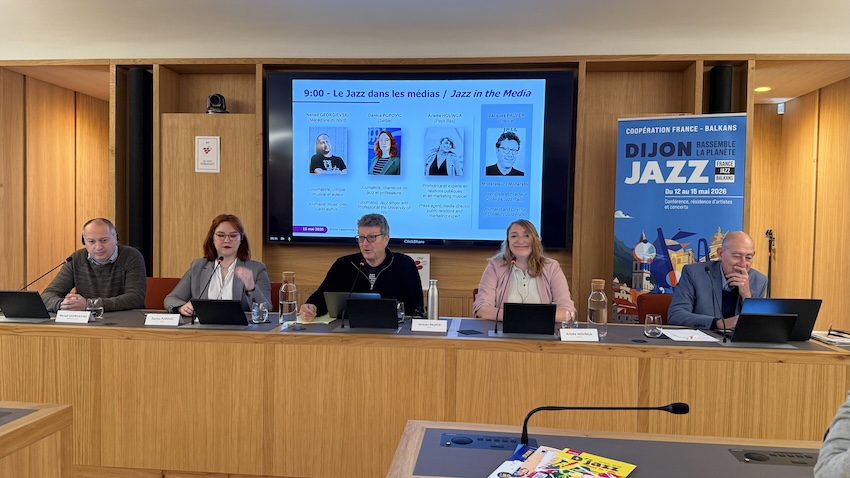
The following morning brought a different setting but the same energy, with a discussion dedicated to Jazz in the media. A sensitive topic in a world where algorithms sometimes seem to prefer cat videos to double bass solos, deceased legends on magazine covers to living musicians from today’s scene, and absurd spectacles like Eurovision over genuine jazz festivals.
Around the table, journalists and public relations professionals spoke openly about the difficulties facing the sector: the gradual disappearance of critical spaces, the fragile economy of specialised media and the relentless speed of social networks. Yet once again, there was no heavy nostalgia hanging in the air.
On the contrary, the exchanges demonstrated that jazz continues to discover new ways to exist, particularly through independent platforms, European networks and a new generation of passionate advocates. Moderated by yours truly, the discussion notably featured journalist Nenad Georgievski representing North Macedonia, Danica Popović for Serbia, and Dutch jazz public relations specialist Arlette Hovinga.
I had the honor of moderating the discussions between the very active audience and my colleagues around this round table.
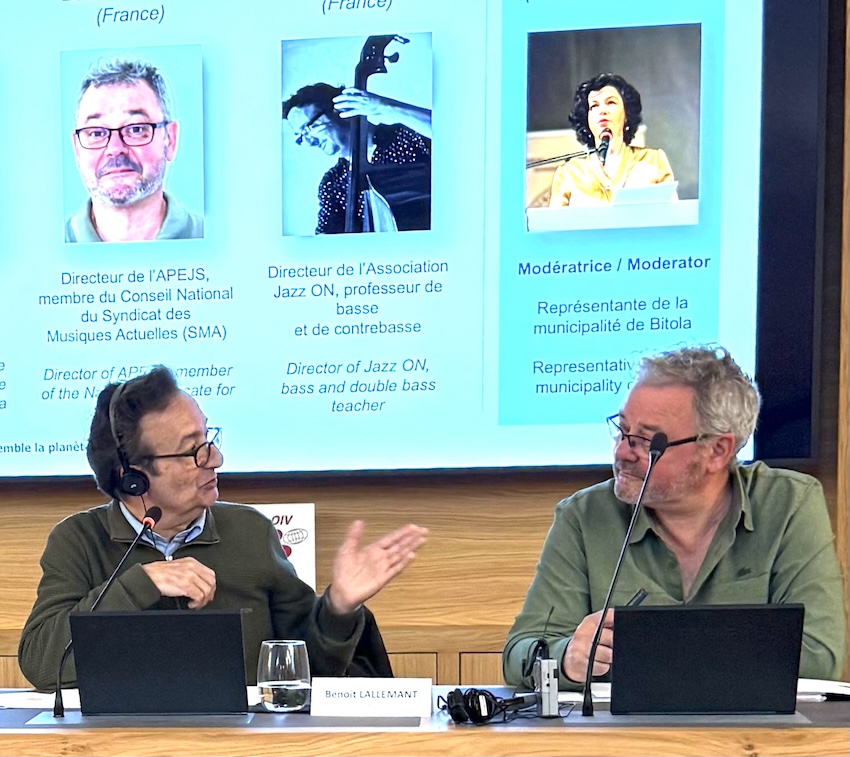
 Another essential topic followed: jazz education. How does one transmit a music built precisely upon freedom, risk and invention? Here again, the discussion avoided simplistic formulas. The speakers stressed the importance of preserving young musicians’ curiosity while also providing them with a strong technical foundation. A delicate equation at times: teaching the rules without extinguishing the desire to bend them.
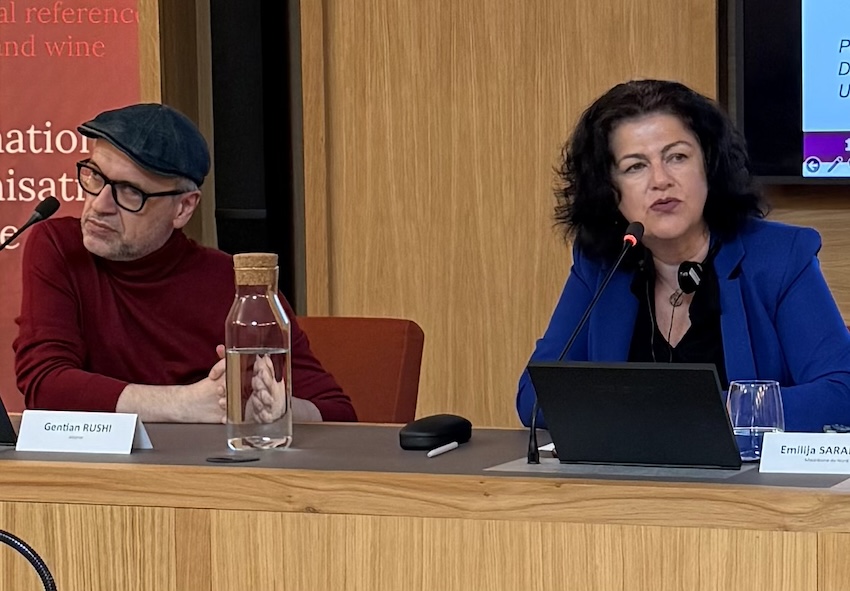 The conversations between Gentian Rushi, founder of the Jazz Department at the University of Tirana in Albania, Bertrand Furic, director of APEJS in Chambéry, Benoît Lallemand, director of Jazz’On Dijon and Andrew Read, Founder of Jazz in Europe magazine, outlined a pedagogy rooted in sharing, equally open to local traditions and international circulation. , The discussions were moderated by Emilija Sarabska, representing the city of Bitola.
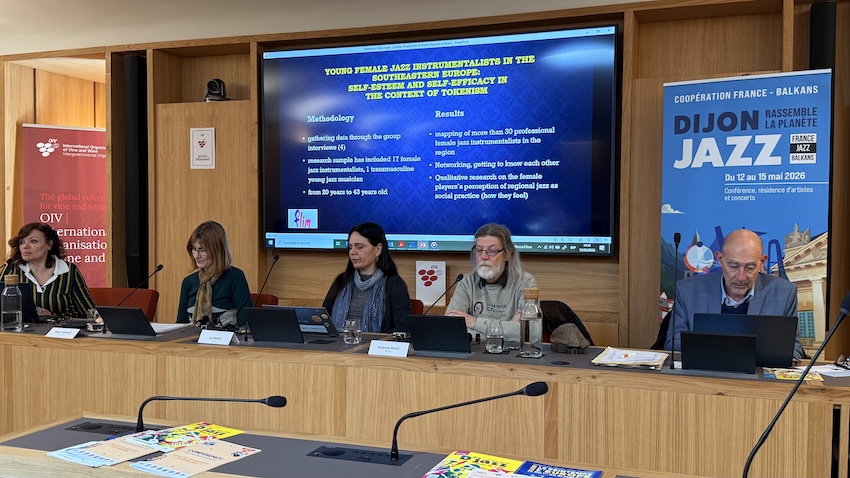
 Finally, the last round table dedicated to “Women in Jazz” brought these rich and convivial encounters to a close. Without superficial activism or predictable rhetoric, the speakers addressed very concretely the obstacles that still remain, the persistent old habits and the urgent need to open jazz scenes more widely. In the Balkans, astonishingly, some jazz big bands still include no female musicians at all. Moderated by Maja Popović, president of the Jazz Art association in Podgorica, and featuring musicologist Iva Nenić alongside multi-instrumentalist Jasna Jovićević, the discussion gained particular depth from both artistic experience and fieldwork realities.
 The beating heart of this edition was undoubtedly the France Balkans Jazz Band residency. For three days, young musicians, mostly young women this year, from the different partner cities worked together at the Dijon Conservatory under the guidance of the network’s mentors. The programme included standards by Miles Davis, Balkan themes, improvisation, last-minute adjustments and that strange alchemy unique to jazz, where musicians who were strangers one day suddenly become a group the next: improvising, listening, playing together and transmitting a joyful, almost improbable energy.
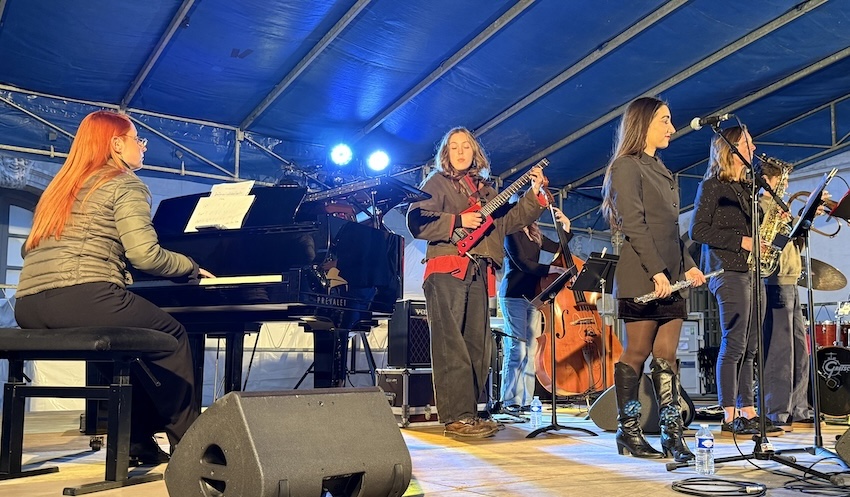
And the symbol was powerful: this year, five of the orchestra’s seven musicians were women, reflecting a very concrete effort to rebalance a jazz scene still too often unequal.
Of course, not everything is always simple. The organisers acknowledged this frankly: certain European funding opportunities remain difficult to secure, several invited cities have not yet joined the adventure and the project sometimes advances with the artisanal elegance of an old van filled with instruments and tangled cables. But it is moving forward. And rather beautifully.
Proof of this lies in the preparation already underway for Phase III of the network, which aims to expand digital tools, strengthen cooperation between music schools, develop educational residencies and perhaps soon open toward Romania, Greece, Croatia and Slovenia.
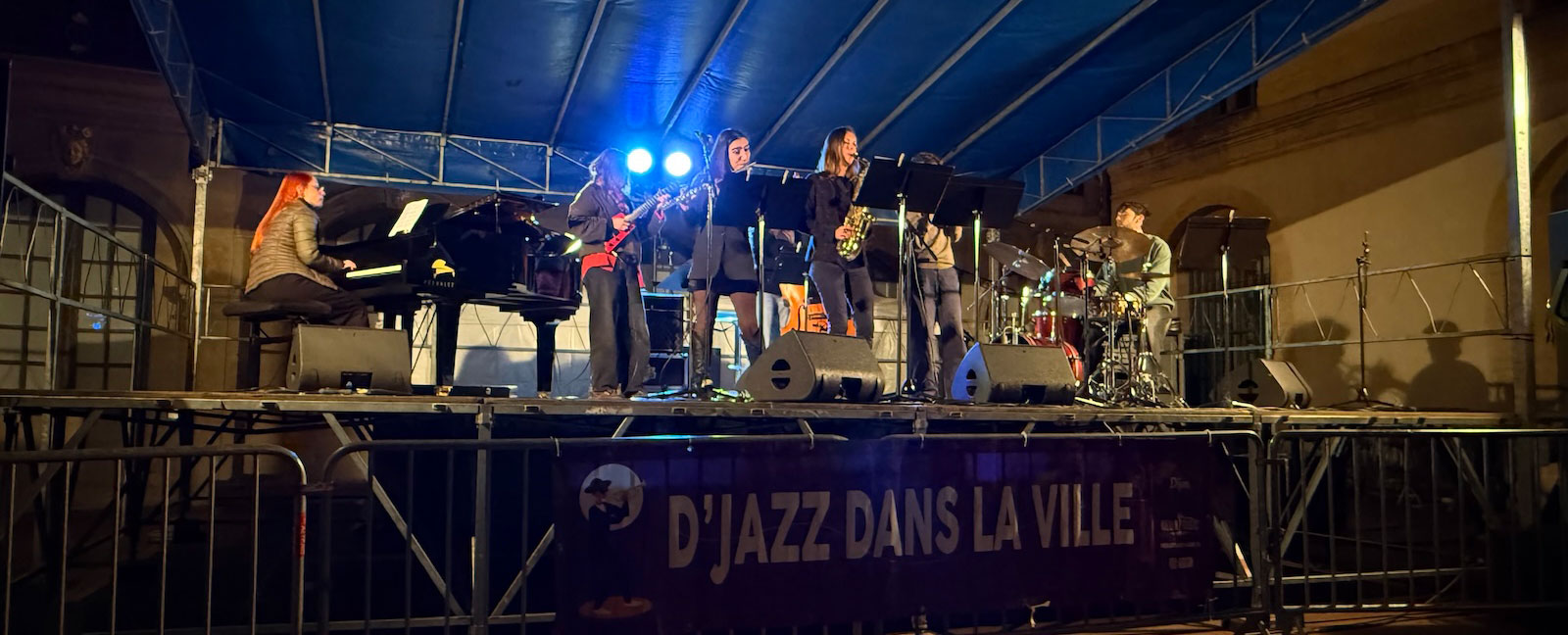
The grand finale took place as part of the D’Jazz dans la Ville Festival, organised by MediaMusic Dijon, with the concert of the France Balkans Jazz Band. (watch the Vidéo)
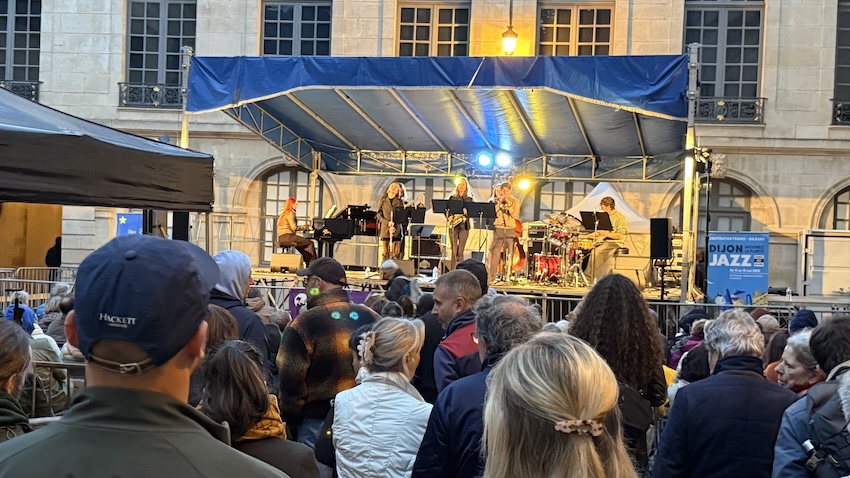 Line Up:
Elsa DONON (France) , Saxophone ;
Tezan HAYRETTIN (Northern Macedonia) Guitar ;
Mina STOJANOVIC (Serbia) Keyboards ;
Nikolina STRUGAR (Montenegro) Double Bass ;
Iris SULA (Albania) Flûte et Vocals ;
Johrim TRIOMPHE (France) Drums ;
Gabriel ZANLONGHI (France) Trumpet.
Then, around 10:30 pm, despite temperatures hovering around only 8°C, came the concert by the trio of North Macedonian guitarist Sašo Popovski. A jazz performance of the highest level. Within the majestic setting of the Cour de Bar at the Palace of the Dukes, the music travelled freely between swing, Balkan melodies and contemporary energy. A free jazz without passports.(See the Vidéo)
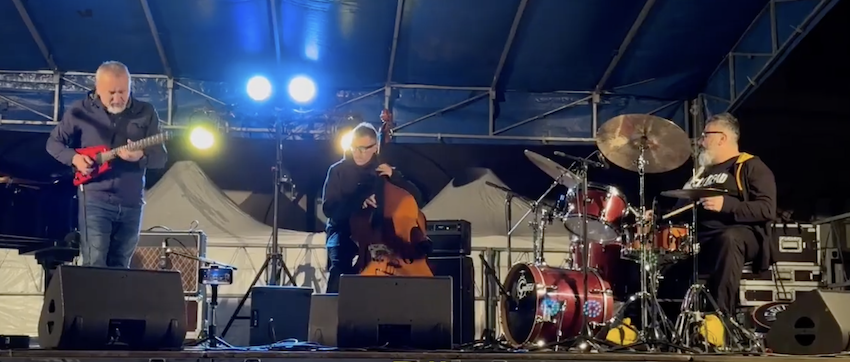 Line Up:
Saso POPOVSKI – guitar ;
Ivan BEJKOV – double bass ;
Aleksandar SEKULOVSKI – drums.
Leaving Dijon that evening, one had the feeling that Europe could still resemble something simple and beautiful: committed cities, instruments, conversations stretching late into the night and musicians capable of understanding one another without translating a single word.
Jazz improvises itself in every colour.
©Photos Gaby Sanchez for Couleurs Jazz.












RECENT COMMENTS