
Cologne, Germany’s Jazz Capital. Although it may be smaller and less imposing than Berlin, Cologne could well claim the title of Germany’s jazz capital.
The city has a long-standing jazz tradition, a vibrant local scene and, above all, a remarkable network of venues where adventurous music has been thriving for decades. Cologne Jazzweek, still a very young festival inaugurated in August 2021, has quickly become another important chapter in that story.
This year’s edition was preceded by a particularly symbolic anniversary: the Stadtgarten concert hall, one of the city’s legendary jazz venues, was celebrating its 40th birthday. The occasion was marked in style on the eve of the festival, with a full night of free concerts both indoors and outdoors.
When music invites you to walk
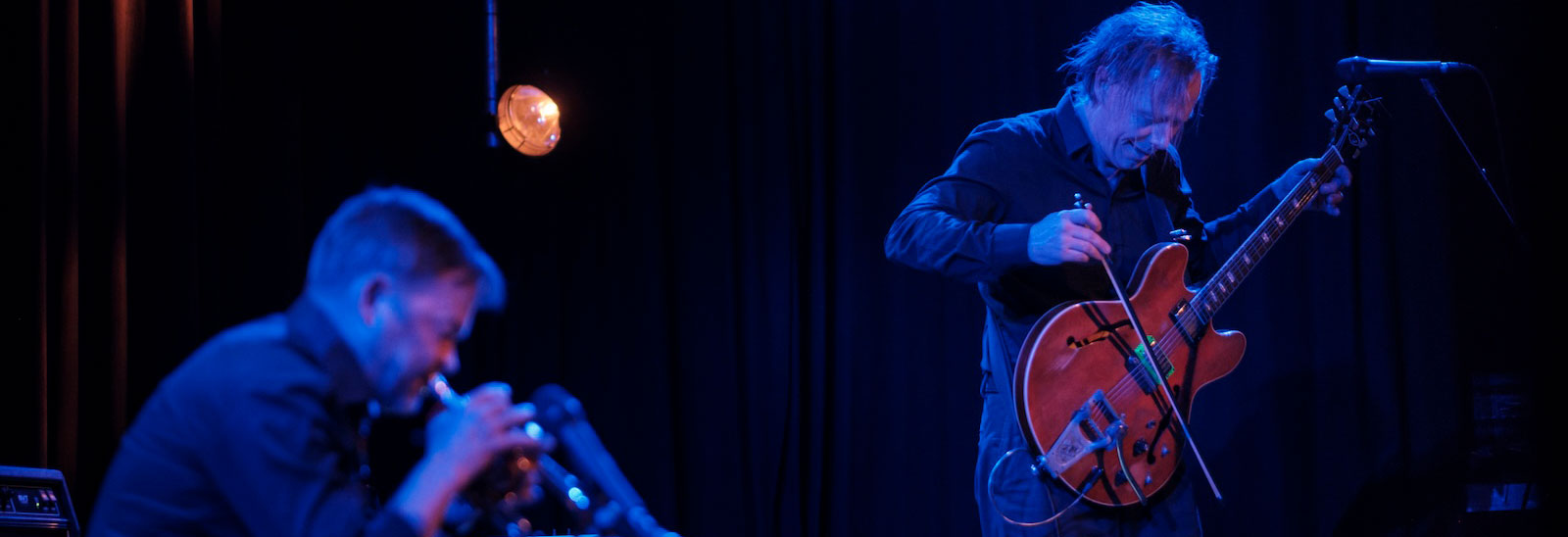
On Friday 4 September, around twenty concerts were spread throughout the Stadtgarten. A large crowd gathered despite the rain that greeted the beginning of the evening. The programme offered plenty of choices, from Norwegian trumpeter Nils Petter Molvær performing outdoors to his compatriots Arve Henriksen and Stian Westerhus playing inside.
But the Cologne scene itself was very much in evidence. Saxophonist Niels Klein appeared with his trio, featuring double bassist Robert Landfermann and drummer Jonas Burgwinkel. Harpist Kathrin Pechlof joined them as a special guest, taking the place normally occupied by a pianist. The following afternoon, the festival expanded beyond the traditional concert venues and invited the audience to discover the city on foot.
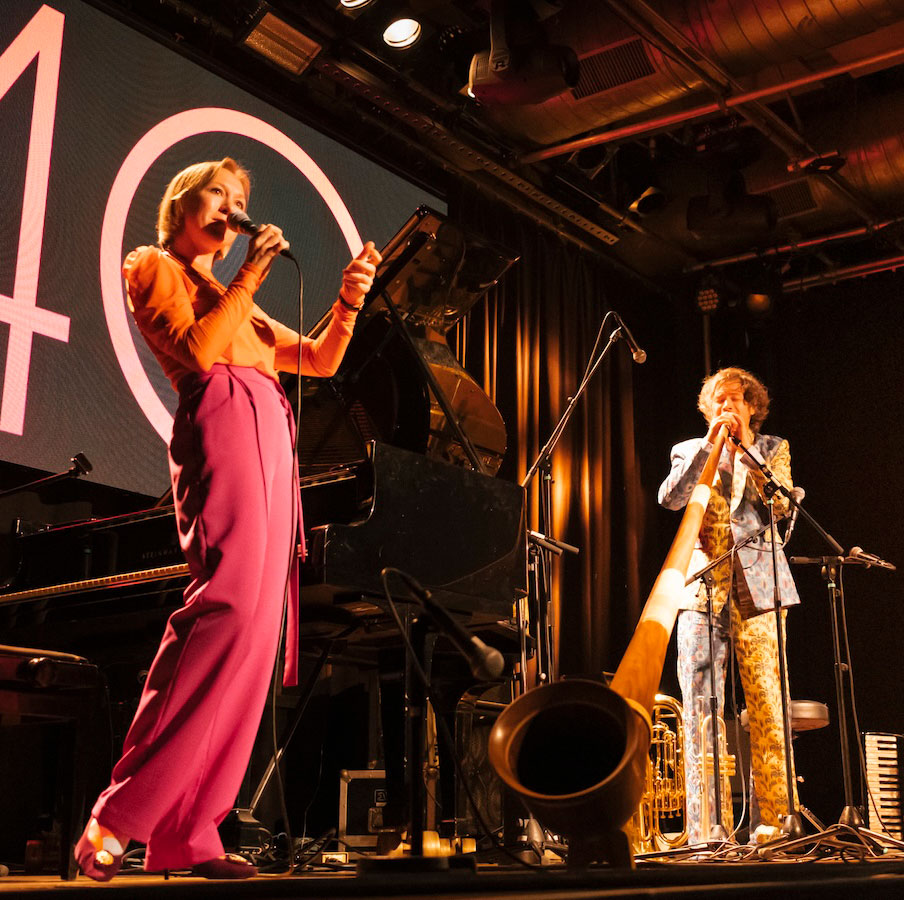
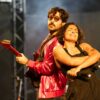
On an outdoor stage, Matthias Schriefl and Johannes Bär appeared with two alphorns. Both musicians are considerably more versatile than the traditional image of an alphorn player might suggest: they also play tuba, trumpet and accordion. Schriefl even seemed capable of playing three instruments at once, dressed appropriately like a clown.
The trees appeared to be following the music, while the notes themselves seemed determined to escape into the air. At one point, the sound engineer had to catch them before they flew away altogether.
After a series of original compositions, singer and pianist Tamara Lukasheva joined the two musicians, adding yodels that immediately evoked the Alps. There are, of course, no mountains in Cologne, although there is a small hill in the nearby park. The audience followed the musicians there to continue the concert.
It was an ingenious version of the festival’s “green walk” concept: first walk, then receive music as a reward.
Jazz as prayer
A short distance away, the Neu St Alban church offered a completely different experience. Damian Dalla Torre’s trio created an atmospheric form of jazz incorporating electronics and bird sounds, with Babett Niclas on harp and Markus Rom on electric guitar. The music gradually drifted towards ambient territory, leaving the listener with a choice: stay and perhaps take a nap, or move on in search of another concert.
In another church, Kathrin Pechlof returned, this time alongside saxophonist Christian Weidner and Robert Landfermann. Here, everything was stripped down to the essentials. The three musicians, dressed in black against a huge white wall, produced a form of pure chamber jazz. Their notes seemed to rise towards the ceiling like prayers, turning the performance into something approaching a musical sermon.
Back at Neu St Alban, organist Janne Nicolas was performing, while Luxembourg vibraphonist Arthur Clees and Ukrainian vocalist Kateryna Kravchenko appeared on a side balcony. Once again, the architecture of the city had become part of the music.
From the cathedral to the Rhine
Sunday arrived under brilliant sunshine. Cologne Cathedral, the city’s majestic landmark, provided a natural starting point for a walk along the Rhine. Unfortunately, its monumental beauty is somewhat compromised by the ugly and intrusive constructions surrounding it — a reminder that even one of Europe’s great Gothic monuments cannot escape the realities of modern urban planning.
The day nevertheless had another musical surprise in store. Matthias Schriefl and Johannes Bär climbed the steps towards one of the cathedral towers, where they played their trumpets and tubas high above the city before starting a musical walk along the Rhine.
Later that evening, the journey continued to the Loft, another mythical Cologne venue. Getting there involves climbing a seemingly endless number of stairs before reaching a small room where two exceptional musicians were about to play: British saxophonist Evan Parker and American trumpeter Peter Evans.
Both are masters of their instruments and, in their own way, of creating music that seems to escape the physical limitations of acoustic sound. Parker is renowned for his circular breathing, while Evans proves to be an ideal partner, the two musicians generating hypnotic textures that can sometime be mistaken for electronic sounds.
Could it be because this music requires a genuine listening effort that one member of the audience eventually fainted? Difficult to say. What is certain is that an ambulance was called, and the musicians briefly interrupted their concert.
That unexpected interruption gave me just enough time to make my way back to the Stadtgarten for the final thirty minutes of Peter Bernstein’s concert.
The guitarist was performing with what proved to be a five-star quartet, featuring the rising pianist Sullivan Fortner. Bernstein offered a programme combining originals with revisited pieces, although Fortner was not always given as much room as one might have wished.
The concert ended with Dissipation Blues, which, despite its title, did little to dissipate the enthusiasm of the audience. The crowd called the musicians back for an encore, and Bernstein responded with Newark News, a rarely played calypso by the late Sonny Rollins with whom he had shared the stage years ago.
A new chapter for the Stadtgarten
After forty years, the Stadtgarten itself is now in need of renovation. Work is scheduled for 2028, and one can only hope that the project will move faster than the construction of Cologne Cathedral, which took no fewer than 632 years.
In the meantime, the Stadtgarten continues to fulfil the role it has played for four decades: a meeting place for musicians, audiences and ideas, firmly rooted in Cologne’s musical landscape.
Cologne Jazzweek may still be a newcomer, but it is building on remarkably solid foundations. Perhaps that is why the festival already feels less like an event imported into the city than a natural extension of a jazz culture that has been growing there for generations.
CJW 5-6 septembre, Startseite – Cologne Jazzweek
Stadtgarten 4 septembre, Stadtgarten Köln | Night of Stadtgarten – Jubiläumsfestival
©Photo couverture : Niclas Weber – Tamara Lukasheva & Matthias Schriefl
©Photo Header : Niclas Weber – Jahre-Stadtgarten, Arve-Henriksen & Stian-Westerhus






RECENT COMMENTS