
For anyone who has been gasping for air beneath the heatwaves that swept across much of Europe this summer, there is an almost improbable refuge.
Lost in the North Atlantic, halfway between Scotland and Iceland, a tiny archipelago where temperatures rarely rise above 15°C continues to live to the rhythm of the wind, the ocean… and music.
The Faroe Islands often remain in the shadow of their spectacular neighbour, Iceland. Yet their sheer cliffs, grass-roofed villages and mountains rising dramatically from the ocean form one of Europe’s most striking landscapes. Here, sheep outnumber the roughly 55,000 inhabitants scattered across eighteen islands, yet the cultural life is remarkably vibrant.
Every summer, Summartónar provides the finest illustration of this vitality. Organised by the Association of Faroese Composers, the festival does far more than simply line up a series of concerts: it takes them on the road. For more than four months, local musicians and international guests travel across the archipelago, turning churches, museums, cultural centres and remote villages into concert venues. More than a festival, Summartónar is a way of inhabiting the territory.
For nearly half a century, Kristian Blak has been shaping the musical landscape of the Faroe Islands. Pianist, composer, founder of the Tutl label and artistic director of Summartónar, he has taken on a mission that goes far beyond organising a festival: bringing music to every corner of the archipelago.
This philosophy is reflected in every one of his choices. Concerts are not concentrated in a prestigious venue, or even solely in the capital, Tórshavn — “Thor’s harbour”, a legacy of the Viking presence. They take place in churches, museums, cultural centres and modest community halls, sometimes at the end of a road that seems to come to a halt at the edge of the ocean. In the Faroes, travelling is an integral part of the musical experience.
Today, the eighteen islands are connected by an impressive network of underwater tunnels that has profoundly transformed the way people move around the archipelago. One of them has become a global curiosity: a roundabout carved beneath the Atlantic and transformed by Faroese artist Tróndur Patursson into a luminous installation. The bluish beams enveloping the space evoke the movements of the traditional chain dance, a symbol of a culture that has never ceased to pass down its history through song.
This desire to take music on the road goes hand in hand with an environmental awareness. This year, with the festival extending over more than four months, invited artists are encouraged to stay for longer periods in order to limit air travel. A simple but coherent approach, perfectly suited to the spirit of the islands: here, time is taken to discover a landscape as much as to share music.
Estonian saxophonist Villu Veski embodied this philosophy perfectly. Invited from 2 to 4 August, he took part in three very different concerts, each revealing a facet of the musical identity that Kristian Blak is committed to promoting.
The first took place in Bøur church, on the island of Vágar. It would be difficult to imagine a more appropriate setting. Overlooking the Atlantic, the small white building seems almost lost between the mountains and the sea. Through the windows, the eye naturally turns towards the famous islets of Tindhólmur and Gáshólmur, while inside, silence reigns, disturbed only by the opening notes of the concert.
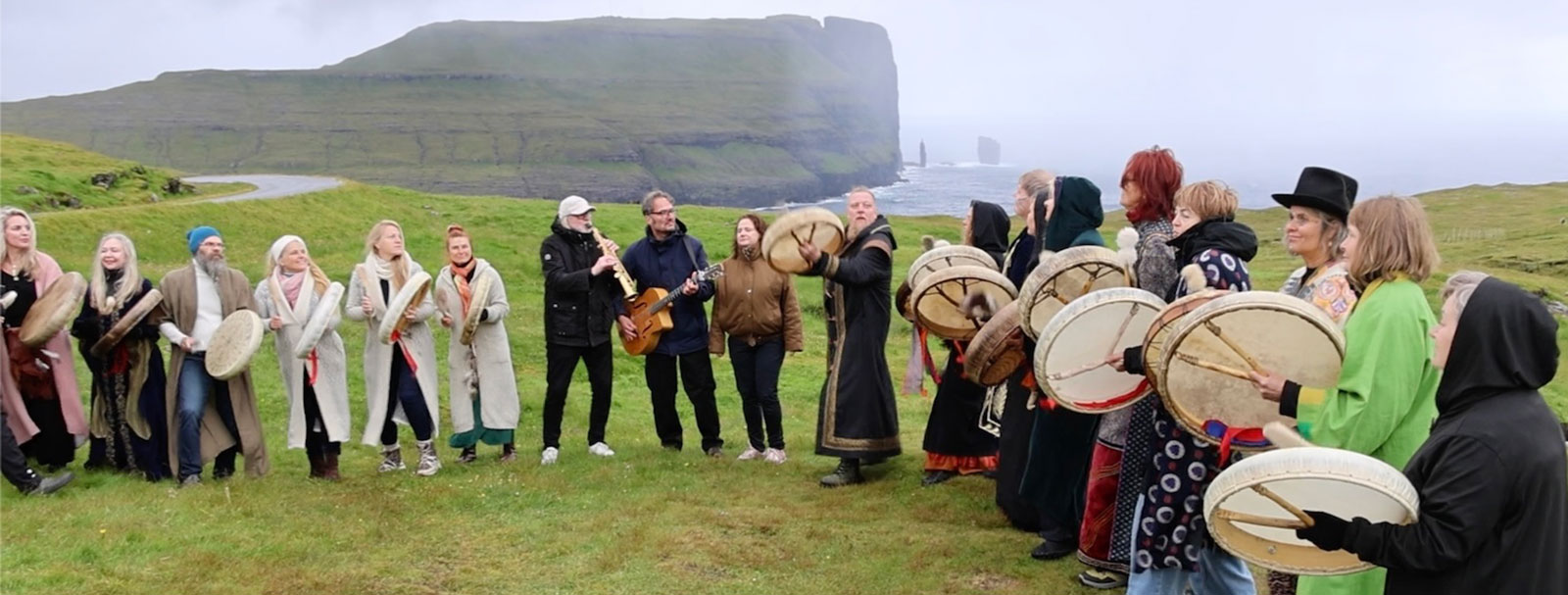
For his Nordic Ballads project, Villu Veski was reunited with Danish singer Katrina Petersen. Thanks to her Faroese family roots, she naturally interprets the archipelago’s ancient ballads, as well as songs in Icelandic and other Nordic languages. Alongside them, guitarist Andreas Ugorskij and keyboard player Raun Juurikas create an atmosphere of great delicacy, before the arrival of the Satro Shaman Drum Orchestra takes the performance into an entirely different dimension.
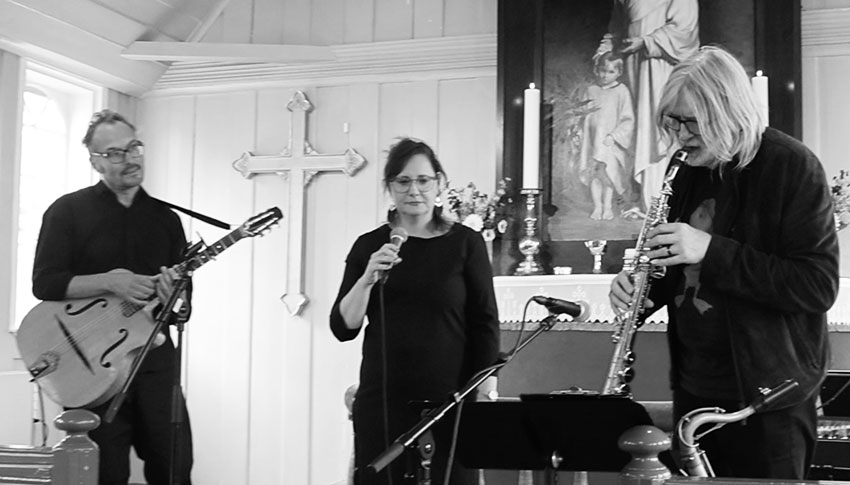
©Photo Rain Käärst
Led by Arno Kalbus, the percussionists never resort to spectacular effects. Their deep pulsations give the concert an almost ritualistic quality. The ancient sagas suddenly seem to come back to life. For a few moments, the boundaries between concert, ceremony and legend disappear. Close your eyes and it is easy to imagine Viking tales celebrating Ragnar Lodbrok’s return from a long expedition.
This taste for encounters between jazz and folk traditions perfectly sums up Kristian Blak’s approach. Since founding the Tutl label in 1977, collectively owned by Faroese musicians and composers, the pianist has never stopped championing music deeply rooted in its territory while remaining open to influences from elsewhere.
As the days go by, one thing becomes increasingly clear: in the Faroe Islands, music is not simply entertainment. It is one of the principal vehicles of collective memory.
Kristian Blak often points out that, for centuries, Faroese musical tradition was transmitted almost exclusively through the voice. Unlike other Nordic cultures, it developed without any significant instrumental accompaniment. Long ballads told of heroic exploits, family tragedies and legends from the sea, while the chain dance allowed an entire community to share these stories.
This intimate relationship between music and transmission becomes strikingly apparent during the concert in Sandur, on the island of Sandoy. The fishing village, peacefully set beside a vast beach, seems to move at a different pace. In a small museum dedicated to local artists, Kristian Blak is joined by Villu Veski and Faroese double bassist Bárður Reinert Poulsen for a programme devoted almost entirely to the archipelago’s musical heritage.
With the exception of a piece by Jan Garbarek, offered as a discreet tribute to one of the great figures of Scandinavian jazz, the repertoire draws on the Faroese oral tradition. Some melodies come from ancient medieval ballads, while others are folk songs transcribed after circulating for generations from mouth to mouth. The modal colours of these old melodies contrast with the simplicity of religious hymns or nursery songs populated by fantastical creatures, reminding us how deeply Faroese imagination remains connected to its environment.
The following day, in Tórshavn, Kristian Blak once again joins Villu Veski in an even more stripped-down setting. Before sitting down at the piano, he takes the time to explain to the audience what makes the local musical tradition so distinctive: here, song long served as the sole vehicle for carrying an entire culture.
The concert takes place in a room dominated by an imposing Steinway. The walls are covered with large frescoes inspired by Faroese epic tales. For a few moments, the figures depicted seem to be attending the concert themselves, as though the ancient legends were still engaged in dialogue with the musicians.
The conversation soon broadens to Greenland, where the two artists have performed several times. Kristian Blak recalls the ethnologists who, at the beginning of the twentieth century, collected the oral traditions of both the Inuit and the Faroese, aware that these cultural heritages were at risk of disappearing. As an epilogue, the pianist performs an old Inuit kayak song. For the duration of a single piece, the cliffs of the Faroes seem to meet the icy expanses of Greenland, reminding us that the peoples of the North Atlantic share far more than a common geography: they share the same need to preserve their stories.
This curiosity about northern cultures runs through Kristian Blak’s entire body of work. While his emblematic group Yggdrasil is firmly rooted in jazz, the composer also writes for contemporary music ensembles. A few days earlier, two of his works had been performed by British violinist Rupert G. Marshall-Luck at the Nordic House in Tórshavn. Another illustration of an artistic freedom that refuses to draw boundaries between genres, much like a festival where jazz is in constant dialogue with folk traditions, contemporary creation and world music.
In the Faroe Islands, modernity has never completely erased tradition. On the contrary, it seems to have provided it with new spaces in which to express itself. Underwater tunnels now connect the islands, artists can travel more easily, yet the songs continue to tell a story that began long before the arrival of this new infrastructure.
This continuity can also be felt during the traditional evenings organised as part of Summartónar at Hotel Føroyar. Reached by a path where a few signs humorously remind visitors that “the path is for visitors, the grass is for sheep”, this vast building, inaugurated in 1983, seems to blend into the hills surrounding Tórshavn.
Before the meal, Kristian Blak and three other musicians perform a recital devoted to Faroese traditions. Then comes the moment many have been waiting for: the chain dance, an ancient practice that has disappeared from many parts of Europe but remains remarkably alive here.
Men and women join hands, move in a circle and sing songs passed down from generation to generation. This is not a folkloric reconstruction staged for visitors, but a tradition still fully inhabited by those who practise it. Music then becomes a collective gesture, a way of remembering together.
Perhaps this is where the true spirit of Summartónar lies. The festival is not simply about presenting concerts in unusual venues. It reveals a particular relationship between a community and its music. In the Faroes, creating, performing and transmitting are not separate activities: they are part of the same movement.
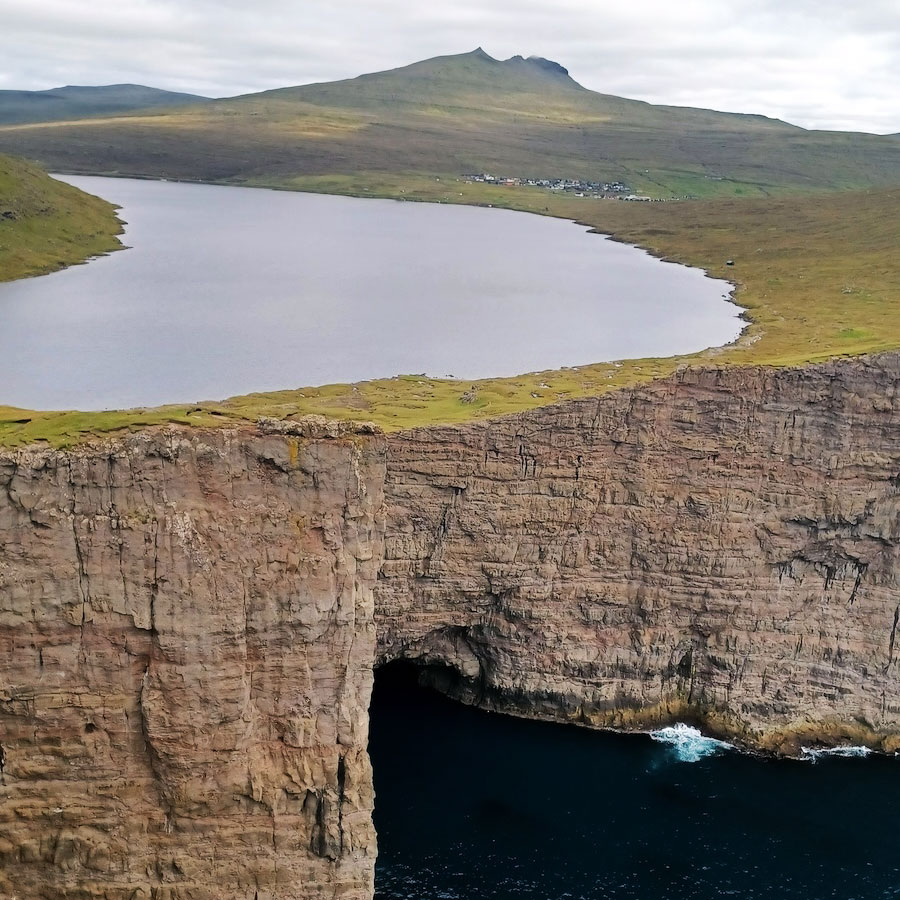
The archipelago can be discovered in many ways. You can explore it by car, cross its spectacular tunnels or follow roads bordered by sheer mountains. But once you leave the roads and take to the trails, it is on foot that these landscapes are best understood. Every turn offers a new perspective: a cliff plunging into the ocean, a village clinging to the coast, a lake suspended above the sea like an optical illusion when viewed from the heights of Vágar’s cliffs.
After a few days in the Faroe Islands, one impression lingers. This is a territory that has found a rare balance between openness to the world and loyalty to its roots. Here, the wind shapes the landscape, but music shapes memory.
As Europe returned to the heat of summer, these northern islands offered a reminder that there are still places where time seems to move to a different rhythm. A rhythm carried by the waves, by ancient voices… and by the breath of jazz.
©Photos et texte Pascal Dorban pour Couleurs Jazz.







RECENT COMMENTS