
The 50èmes hurlants Trio: Where Jazz Meets Poetry
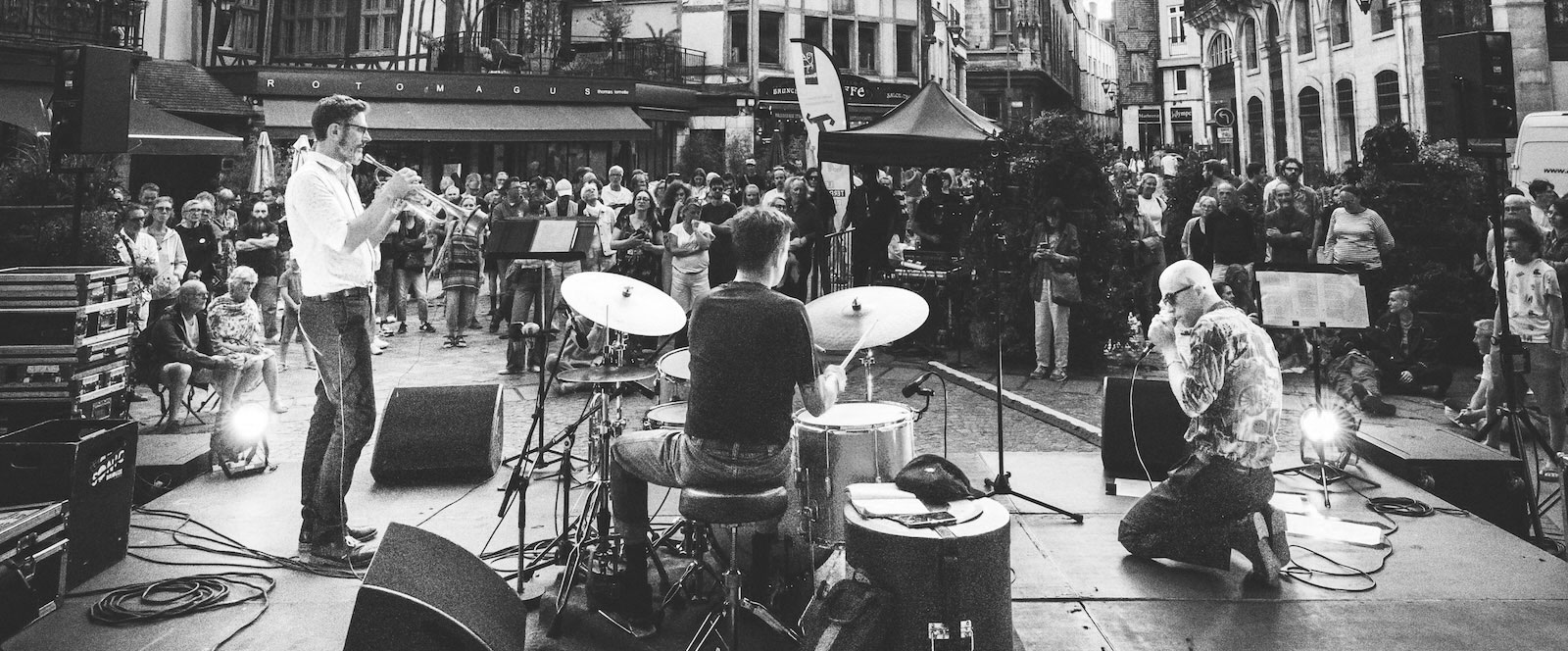
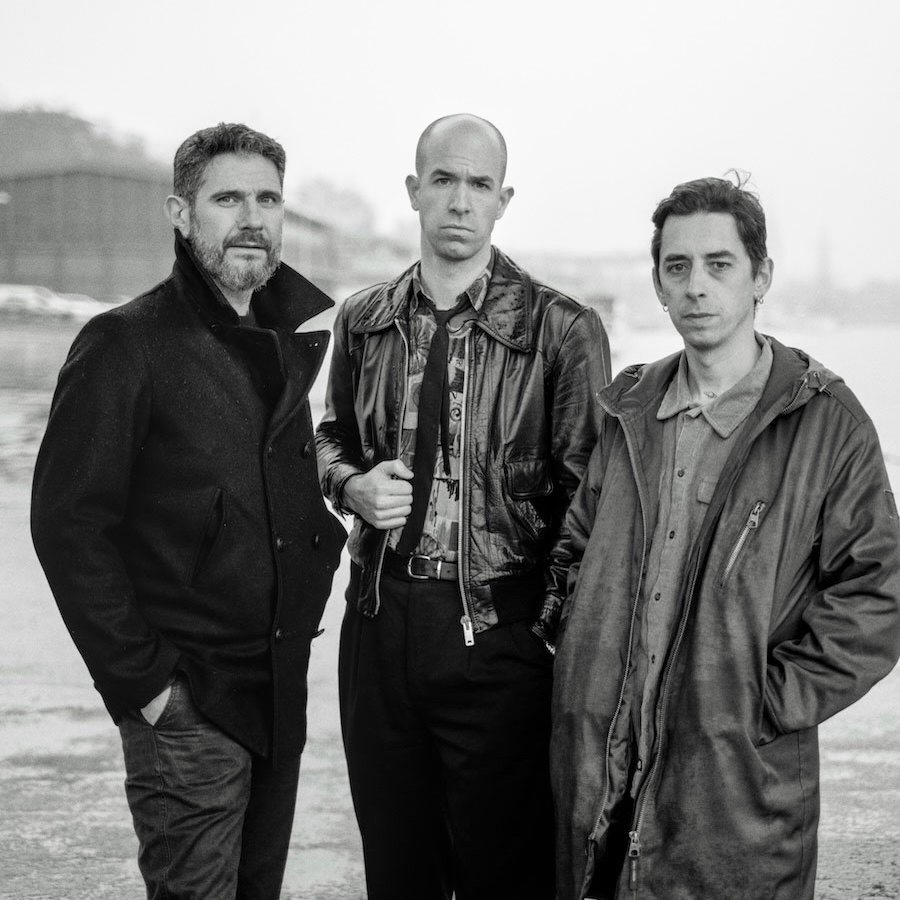
Led by poet Tom Buron, the 50èmes hurlants Trio brings together trumpeter Fred Aubin (La Maison Tellier) and drummer Grégoire Mainot (MNNQNS). Their new live session blends jazz and poetry.
Eric Dolphy, Zorn, Mingus & Coltrane
Fred Aubin: We initially embarked on a tour of around a dozen concert-readings of Les Cinquantièmes hurlants, performing as a duo to mark the publication of Tom’s book by Gallimard last year. We played at the Maison de la Poésie in Paris and Nantes, La Maison du Livre in Brussels, and other venues. During the tour, we both felt the need to expand the lineup. Tom was already adding a little percussion, but we wanted to take things further.
I immediately thought of Grégoire, an inventive drummer with a very open-minded artistic approach. We met in the jazz department at the conservatory, although we belong to different generations, and crossed paths again years later with La Maison Tellier, when he filled in for our regular drummer for around fifteen dates. His work with MNNQNS, combined with his versatility, made him the obvious choice. He joined the adventure, and we set about adapting Tom’s powerful, monumental text from duo to trio.
Tom Buron: When Grégoire joined us last winter, we immediately booked a performance for two months later at La Baraque in Rouen, a venue I’m particularly fond of. That’s how it all began. We wanted to move quickly and capitalize on the interest surrounding the book, which had just won the Prix Apollinaire Découverte.
After four or five weeks of studio work, we had transformed our duo performance into a trio, making numerous changes to the structure so that the drums would be much more than simply an accompaniment. By December, the 50èmes hurlants Trio was born, and in February we played our first concert. We were fortunate to secure some excellent dates soon afterwards, including the Terres de paroles and Jazz & poésie festivals, followed this summer by Les Terrasses du jeudi, a festival aimed at a broader audience. We also had the opportunity to present this jazz-and-poetry project on TSF Jazz’s morning shows.
Tom Buron: The original idea was to start with jazz and bring it into contact with other genres we love, while combining it with poetry that is spoken, embodied and rhythmically delivered. As far as the voice is concerned, my influences tend more towards rock and blues. I listen to a lot of the Lounge Lizards, Eric Dolphy, Zorn, Don Cherry, Mingus, Ornette Coleman, Coltrane, Pharoah Sanders and Monk, as well as contemporary musicians such as James Brandon Lewis, Shabaka Hutchings, Ambrose Akinmusire and Isaiah Collier, to name just a few.
I’m also a great admirer of my friend Antoine Berjeaut, with whom I have a project leaning towards jazz and electronics. His album Moving Cities, produced by Makaya McCraven, is well worth hearing. More recently, I’ve particularly enjoyed Stéphane Kerecki’s Charlie Haden tribute, Liberation Songs, Immanuel Wilkins’ Live at the Village Vanguard, and James Brandon Lewis’ Deface the Currency with the Messthetics.
To come back to the Trio, I think we’re making a kind of jazz-rock steeped in poetic prose, for people who enjoy unconventional forms.
Grégoire Mainot: My musical background is rooted in rock. My entry into jazz came through the same combination of musical lineage and curiosity. A friend at the conservatory introduced me to Joshua Redman, and Brian Blade’s playing was a revelation. He then opened the door to Max Roach for me. Today, I’m convinced that both drummers have profoundly shaped my approach to jazz.
Beyond these guiding figures, I’ve always been fascinated by improvisation, particularly the idea of constructing a musical statement in real time within a precise framework. Finding freedom within constraint. It’s central to jazz, but I also recognize the same principle in composers of repetitive music such as Steve Reich and John Cage: imposing strict rules in order to explore the space more freely.
On drums, the possibilities are infinite. You can do virtually anything and imagine anything. Setting yourself a context, a framework in which to play, in order to improvise more freely is something that stimulates me enormously. And that’s precisely what Tom, Fred and I are exploring with the Trio.
Fred Aubin: Miles Davis, of course. His music offers a remarkably broad panorama of jazz, from bop to the experimental. I was also deeply influenced by Chet Baker, whose expressiveness, timing and refusal to compromise artistically have always fascinated me. Then there’s Tom Harrell. His themes are so economical that they sometimes verge on naïveté, yet his solos are so inspired that I consider several of them models for modern jazz. His album Number Fivealso introduced me to the trumpet-and-drums duo, without bass or piano.
And finally, the great master: Wynton Marsalis. More than simply being one of the world’s greatest trumpet players, he has become the guardian and transmitter of a century of African-American musical culture. He is the only one who can bring Armstrong and Coltrane together in his playing while still expressing his own artistic sensibility.
Coming back to our own trumpet-and-drums combination, the absence of a bass or harmonic instrument has never been a problem. Quite the opposite: it’s what makes us distinctive. It opens up an extraordinary expressive potential that I hadn’t even suspected myself. The interplay happens directly, without constraints.
There’s something here that connects with contemporary music: the search for effect and expression comes first, whatever the means. I impose certain modal constraints on myself as a basis for the themes and their development. But this is quite different from a traditional jazz quartet or quintet, where the structure is more clearly defined and each musician has a specific role. Here, the two instruments engage directly with each other and with the voice, all on equal terms.
Cinquantièmes hurlants
Fred Aubin: We tried to structure Tom’s long, complex text in a way that would allow the audience not only to understand it, but to feel it. We didn’t want mere musical wallpaper. The music had to be an integral part of the text.
I should add that it was Tom’s spoken delivery, and its musicality, that helped me find themes, structures and atmospheres, much more readily than the written page. We weren’t trying to fit into any particular style. We simply followed our instincts to build the piece. That’s why it moves between sea shanties, blues, passages inspired by Elevator to the Gallows, Sketches of Spain, Coltrane-influenced jazz and contemporary atonal music. All these elements are there.
Since I play a wide range of styles, from jazz and classical music to rock and folk, I no longer pay much attention to the boundaries between genres. Things emerge naturally when they feel right for that particular moment.
Tom Buron: It began with the sea. The poem tells the story of a lost sailor’s chaotic voyage in search of an island, and we divided it into three parts, three pieces. We needed a theme that would evoke the maritime setting. I had something along the lines of The Pogues in mind, and Fred quickly came up with the sailor’s theme we hear at the beginning and which returns later on.
The foundation is largely jazz and blues, but, as Fred says, classical music and hints of bossa nova also find their way in. For Cinquantièmes hurlants – Part III, I told Fred I was thinking of Sketches of Spain and fragments of pasodoble. That was roughly the direction I had in mind. There was something tragic about it, but also something combative. I could picture a fighting bull somewhere in the mix…
Grégoire Mainot: I’d focus particularly on the dynamics of the trio and on what Fred and Tom asked me to bring to the drums. From our very first conversations, the challenge was clear: the drums had to carry a genuine musical statement.
We soon discussed Antonio Sánchez’s soundtrack to Birdman, which he composed and performed in its entirety. He’s an exceptional drummer, and the idea struck me when I discovered the film. The whole soundtrack rests on the drums, which become the main narrator, much as a solo piano might.
It also reminded me of a skateboarding segment I’d seen, where the images were driven entirely by acoustic drums in free improvisation, very much in the contemporary jazz vein.
That illustrative approach guided me with the Trio, with one crucial difference: here, we’re not providing a soundtrack to images, but bringing a text to life. Thinking of the drums in this way, with a sound that is raw, organic and almost vulnerable, was the real driving force behind developing my playing and integrating it into the Trio’s sound.
Music & Poetry
Tom Buron: How does it work? We listen to one another… My writing is naturally very much influenced by music. We think as a trio, while each of us also has our own space.
For years, I recited my texts at festivals and venues alongside musicians I’d never met before: saxophonists, pianists, cellists, guitarists, all sorts of players. Often, it was completely improvised. It wasn’t always easy. Some musicians were used to working with spoken-word performers, others weren’t at all. I learned a great deal from those experiences.
With Les Cinquantièmes hurlants, apart from sections specifically designed for solos and improvisation, everything was worked out down to the last detail. Through repeated rehearsals, we developed shared gestures and instincts. When we recorded this live session at La Fabrique de Sigy, the second take was the one. We know where to meet one another musically.
We’re now working on shorter pieces, some with a more conventional verse-and-chorus structure. But Les Cinquantièmes hurlants was a monumental undertaking…
Fred Aubin: Exactly. Certain powerful words or lines also determine the structure. They act as markers, either separating two sections or giving us a musical meeting point, between two of us or all three. They can be repeated or linked to a musical motif.
The return of certain themes helps consolidate the whole structure and gives it a kind of symmetrical clarity. We also identify the moments when the text needs to breathe, making room for improvisation. The result is both solidly constructed and fluid: it changes from one concert to the next, yet always retains its structure.
Grégoire Mainot: There’s something quite funny I’ve come to realize over time: of all the art forms I’ve encountered, poetry has never been the one that came most naturally to me. So when I discovered Les Cinquantièmes hurlants, I initially thought it was an exceptionally intricate text. I even reassured myself by thinking, “It’s normal if I don’t understand everything. My role is to inject music into it. I’ll find my own way of existing within it.”
In reality, through repetition and by setting the words to music, the meaning gradually caught up with me. Today, I’m much better at distinguishing between the literal meaning and the sheer musicality of the words.
As Fred said, we never really struggled with the absence of a traditional harmonic foundation. Everything happened organically. We don’t try to over-illustrate the text, because that would lead straight to cliché or caricature. In the end, the text emerges with a new depth and takes on an entirely different dimension, carried by the raw energy and dynamics of our trio.
Tom Buron: Exactly. It takes on such a different dimension that, in the finished piece, it is no longer a matter of accompanying a text. It’s simply three energies responding to one another and becoming one, with the voice of the text acting as an instrument in its own right.
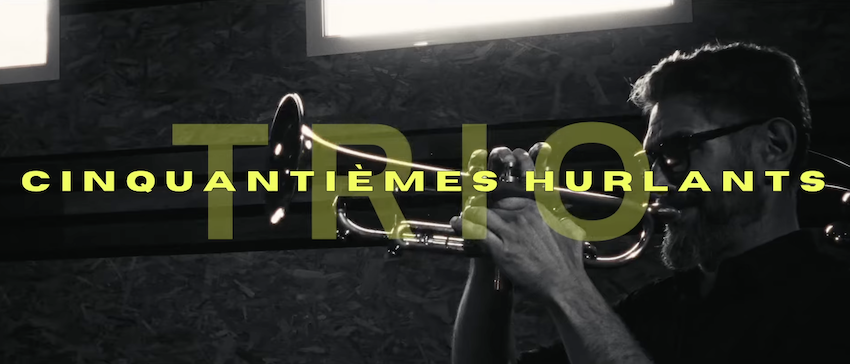
To watch the video, tap on the image:
Interview by Franck Médioni
©Photo couver Morgane Baudry
©Photo Header Mélanie Lhote





RECENT COMMENTS