

At Au Grès du Jazz, the Sun Also Rises Over the Northern Vosges
This summer, the destination is Alsace, even if the temperatures are just as high here as elsewhere. At this rate, the storks may well decide to stay year-round. Following a country road, it is easy enough to reach the village of La Petite Pierre, which has provided the main setting for the Au Grès du Jazz Festival for more than twenty years. Now in its 23rd edition, held from August 8 to 16, the festival has also been awarded an eco-responsible label, a distinction the organisers can rightly be proud of.
The festival’s name is far from accidental. In this part of the Northern Vosges, pink sandstone is everywhere, reaching as far as Strasbourg’s majestic cathedral. But there is no need to travel that far to appreciate its presence. Just a few kilometres from La Petite-Pierre, the troglodyte houses of Graufthal offer a particularly moving testimony to the daily lives of the families who inhabited these modest dwellings carved into the rock until the late 1950s.
This pink sandstone inspires more than cathedral builders. Just ask Ève Risser, an Alsace-born musician who has recently created the Pink Desert Orchestra. On the evening of August 14, the pianist presents the premiere of this brand-new project, built around the rock formations that are a source of pride for the region. Most of the pieces are named after the mysterious rock formations of the Taennchel plateau.
With this new sextet, featuring instruments rarely heard in jazz, such as Yann Gourdon’s hurdy-gurdy, Ève Risser seeks to create a mineral, geological music, carved from the same stone as the walls of the castle whose ramparts can be seen behind the stage. Saxophonist Grégoire Tirtiaux also plays the guembri, an instrument more readily associated with the Moroccan desert than with the cliffs of the Vosges.
The strings creak and groan, while the music deliberately takes its time—perhaps too much so, as monotony is never far away. There are nevertheless some fine moments, particularly when the different strings intertwine. At times, the music also takes on a medieval quality that fits surprisingly well with the setting. After this premiere, however, the project will need time to mature and fully find its shape.
Spain at the Foot of the Castle
A few days earlier, it is another kind of stone—hot and sun-baked—that seems to have taken over the castle square. Spain has arrived in La Petite-Pierre. A flamenco guitar can be heard, soon joined by the instantly recognisable sound of the Concierto de Aranjuez, the starting point for Sketches of Spain. Erik Truffaz then emerges from the shadows, his hat firmly planted on his head. The audience is already cheering as the musicians gradually take to the stage.
It becomes clear that this is going to be a spectacular show when saxophonist and co-leader Antonio Lizana begins playing alongside Truffaz. The night is about to get even hotter. Then the bailaora, Sara Sanchez appears, dressed entirely in white. The two Spaniards face one another: she dances, Lizana sings. Within seconds, the Vosges landscape disappears, replaced by the Sierra Nevada, with Granada’s Alhambra rising majestically above the horizon.

Sketches of Spain is a relatively short piece, so thoughts soon turn to what comes next: a succession of musical sketches, the first of them written by the clarinettist, who is also co-responsible for the arrangement of Sketches of Spain.
Like the solar eclipse of August 12, which was due to be total in Spain, the concert on Sunday the 9th becomes a spectacle of incandescent beauty. Later, the dancer will wear a red dress, as if the Spanish sun has finally defeated the moon.
Tonight, the sun triumphs over the moon. A Spanish sun that illuminates everything in its path, even the doomed lovers of La Ley del Deseo, Pedro Almodóvar’s film that brought Antonio Banderas to international attention. Lizana and the bailaora look at each other once again as if, like the lovers in the film, they were about to cross into the afterlife in one final act of love.
Of course, nothing of the sort happens. But passion surrounds us a little more with every passing moment, and the boundaries between jazz and flamenco gradually disappear. The audience remains almost transfixed by such a combination of musical and visual beauty. Long life to this truly unique project.
A Parisian Night in Havana
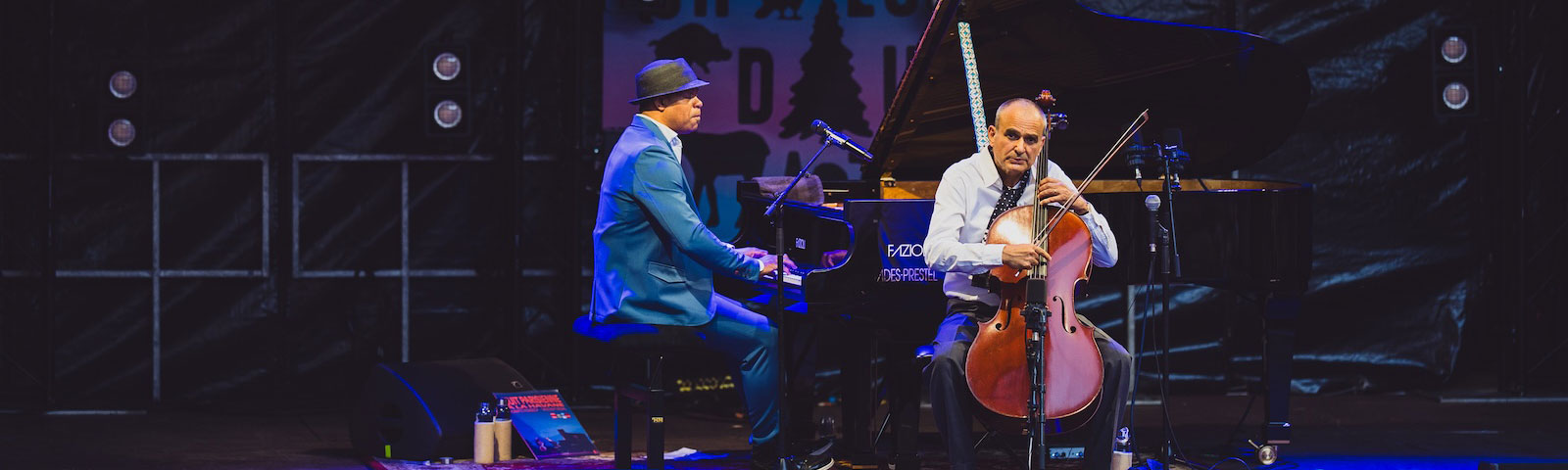
On another evening, a completely different atmosphere prevails on the castle square. The delicate duo of Roberto Fonseca and Vincent Segal offers an intimate concert, almost a classical music recital, with only occasional danzón rhythms introducing a touch of improvisation.
With Nuit parisienne à La Havane, we are indeed a long way from the pianistic exuberance to which the Cuban pianist has accustomed us. Fonseca seems to have deliberately chosen restraint, leaving more room for his dialogue with cellist Vincent Segal. Chamber music in almost the literal sense of the term, while still retaining a few unmistakable scents of Havana.
A Musical Siesta Under the Sun
During a musical siesta organised in the Jardin des Poètes, overlooking the village, the heat forces the musicians to adapt their approach. Double bassist Laurent Gauthier, his partner, the Mexican vocalist Bertha Guadalupe Perez, and guitarist Pierre Brouant eventually settle down in the grass, surrounded by the audience.
Their respective strings tremble more than the branches of the century-old hornbeam whose exhausted limbs bend under the heat, unable to provide the spectators with even the slightest shade. The setting is ready. Everyone has found their place, even if we are all suffering under the temperature.
With a programme devoted entirely to Mexican and South American themes, how could it be otherwise? These love songs are often heartbreaking, as in Alfonsina y el mar, where passion drives the heroine into the sea until she disappears beneath the waves. The boleros follow one another before the musicians bid farewell to the audience with the famous La Llorona.
Chamber Jazz for Robinson Khoury
Once Ève Risser’s concert is over, the pianist and cellist do not even need to leave the stage: they are members of trombonist Robinson Khoury’s Demi-Lune quartet. And since this is very much chamber jazz, the term “quatuor” seems more appropriate than “quartet.”
Sometimes inspired by J. S. Bach, sometimes by something entirely different, Robinson Khoury’s compositions need no common denominator. They are simply the result of his inspiration. Two dance-inspired pieces follow one another, somewhere between a sarabande and a bourrée.
The trombonist’s music is complex, but it is presented without a hint of self-consciousness. It refuses categories and easy references, leaving the four musicians free to make their different worlds interact with one another—a freedom that seems particularly suited to the festival’s setting.
Abbey Lincoln as the Grand Finale
The evening was finally to come to a beautiful close with a vibrant tribute to the music of singer, poet and activist Abbey Lincoln. Returning to a festival she had previously attended alongside Archie Shepp, vocalist Marion Rampal, beautifully accompanied by pianist Thibault Gomez among others, feels sufficiently at home in a place she knows well to deliver a performance that is both intense and deeply intimate.
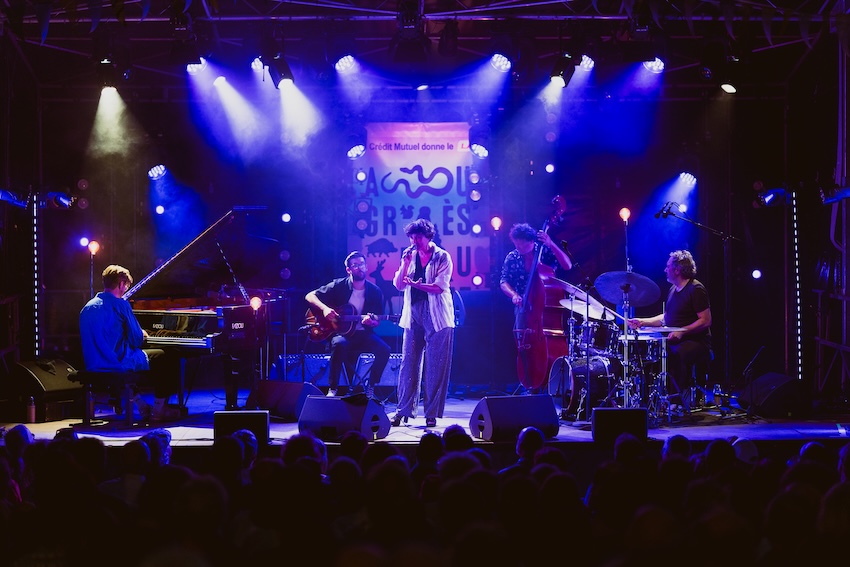
She recalls her previous appearance, when she was pregnant with her daughter Alma, and performs one of the pieces she sang with Archie Shepp at the time. Alma, now all grown up, is actually there that evening, standing behind a stall selling her mother’s records. This almost family-like detail lends the concert an especially touching dimension.
None of Abbey Lincoln’s major compositions is overlooked. Marion Rampal goes even further, performing a poem that was never recorded and translating it into French. It is a reminder that Abbey Lincoln’s legacy cannot be reduced to a handful of standards: it is also the legacy of an engaged woman whose poetry and voice never ceased to carry a singular message.
And so another edition of Au Grès du Jazz comes to an end, in a village where pink sandstone is more than just an omnipresent feature of the landscape. It becomes, in turn, a setting, a source of inspiration and a musical material. Between flamenco and jazz, chamber music and bolero, poetry and improvisation, La Petite-Pierre has once again demonstrated that, in the Northern Vosges, music knows perfectly well how to tune itself to the stones that surround it.
©Photos Celim Hassani

















RECENT COMMENTS