
Let’s be clear: fortunately, the Morgenland Festival is not the German equivalent of Tomorrowland.
Founded in Osnabrück, northern Germany, in 2005, the festival set itself the mission of showcasing the richness and diversity of Eastern musical cultures. In a time marked by a needless war waged by a narcissistic despot, the festival allows us, for a few days, to forget the dystopian world into which we have been unwillingly plunged. With two to three concerts every evening, the 2026 edition took place from May 29 to June 6.
Far transcending the boundaries of traditional Eastern music, the festival embraces a wide range of aesthetics, including jazz, and serves as a genuine bridge between cultures—“Al Qantara” in Arabic, the title of an album by Moroccan musician Majid Bekkas. This mission is embodied in artistic encounters such as the one bringing together Ukrainian singer Ganna Gryniva and percussionist Laura Robles, who was born in Eswatini and raised in Peru.
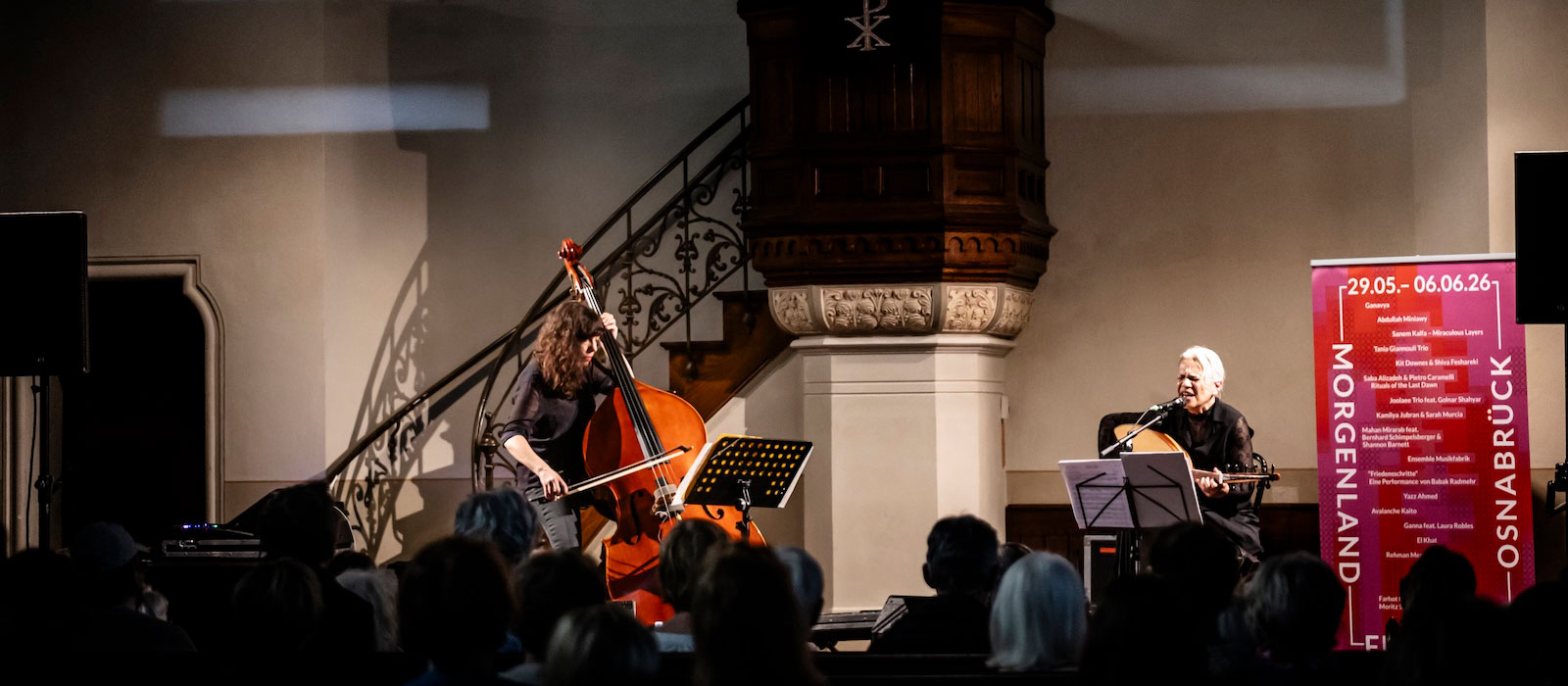
On June 2, another duo took the stage in the intimate setting of the Bergkirche. French double bassist Sarah Murcia, who recently celebrated her 50th birthday, is among the most creative figures on today’s European jazz scene. Her presence at the Morgenland Festival perfectly reflected the event’s commitment to highlighting the music of tomorrow. Joined on stage by Palestinian singer and oud player Kamilya Jubran, the two billiards enthusiasts (they were due to spend the rest of the evening around a table enjoying their favourite game) displayed remarkable musical rapport throughout a concert marked by unmistakably Eastern sonorities. Through her compositions, Kamilya Jubran led the audience on a musical journey in which the strings of her oud seemed to naturally extend the inflections of her voice. Opposite her, Sarah Murcia’s double bass made the most of the near-perfect acoustics of the Reformed church. Only the rain, at times drumming against the roof, briefly distracted the attention of an audience that was clearly won over.
Later that evening, at the Lagerhalle—the festival’s main venue and headquarters—Iranian guitarist Mahan Mirarabpresented UNSPOKEN, his first album released on ACT Music. As several pieces from the album are performed solo, he naturally began the concert alone, armed with his double-neck guitar. His distinctive musical language, situated at the crossroads of Persian traditions and contemporary jazz, is the result of many years of research and experimentation. He also took his time writing and recording themes that are sometimes deeply personal, including pieces dedicated to his grandmother, who passed away during the recording of the album. After two solo performances, Mirarab was joined by Austrian percussionist Bernhard Schimpelsberger.

Together, the two musicians occasionally transported the audience towards Indian musical landscapes through exchanges of Carnatic singing. The duo then became a trio with the arrival of Australian trombonist Shannon Barnett, a key figure on Cologne’s jazz scene. While neither Schimpelsberger nor Barnett appears on the album, singer Golan Shayar, Mahan Mirarab’s partner, made a surprise appearance towards the end of the concert, notably on Lars in Isfahan, a composition dedicated to Lars Danielsson and recorded in the cellist’s studio in Gothenburg.
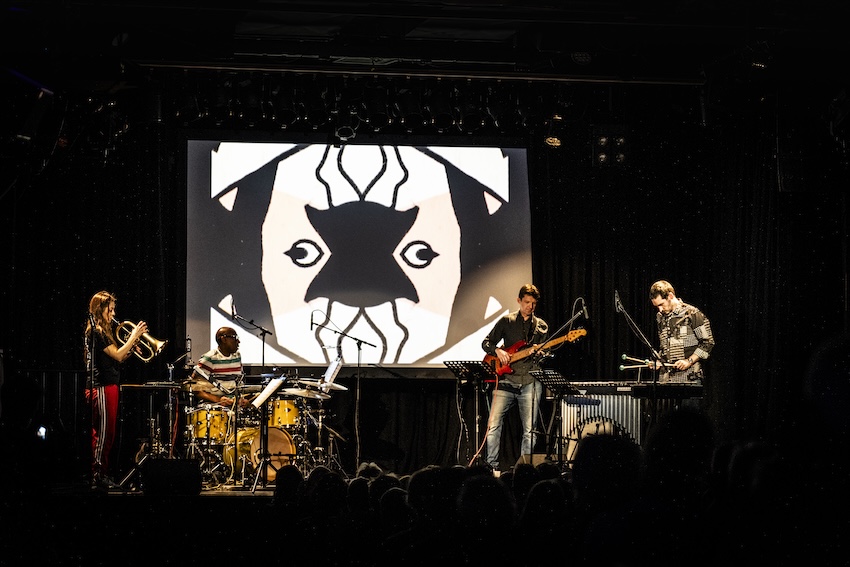
The following day, the British jazz scene took centre stage at the Lagerhalle with the appearance of Yazz Ahmed. British through her father and Bahraini through her mother, the trumpeter embraces her multiple roots through a contemporary jazz language infused with Eastern influences and occasionally contemplative atmospheres. Having arrived from London the previous day without her luggage, she was accompanied by fellow Britons Ralph Wyld on vibraphone, Dave Manington on bass, and Rod Young on drums, who succeeded the late Martin France following his passing in 2024.
Widely regarded as one of the finest drummers of his generation, Martin France played a major role in Yazz Ahmed’s artistic development. His absence is still keenly felt within the ensemble today.
Present at every concert, Morgenland Festival’s new artistic and enthusiastic director, Shabnam Parvaresh, delivered a particularly eclectic programme, faithfully reflecting the music of today and tomorrow. A clarinettist and former member of the Tehran Symphony Orchestra, she first discovered Germany during an earlier edition of the festival in Osnabrück.
This also provides an opportunity to recall that, following the Peace Treaties of 1648 that brought the Thirty Years’ War to an end, Osnabrück and Münster were granted the honorary title of “Cities of Peace.” It is a reference that resonates strongly at a time when numerous conflicts continue to dominate international headlines. While war may sometimes resume when the music stops, the Morgenland Festival reminds us, for the span of a week, that music remains one of the most powerful languages of dialogue between peoples.
©Photos Morgenland Jazz Festival.















RECENT COMMENTS