

To The East of Haden
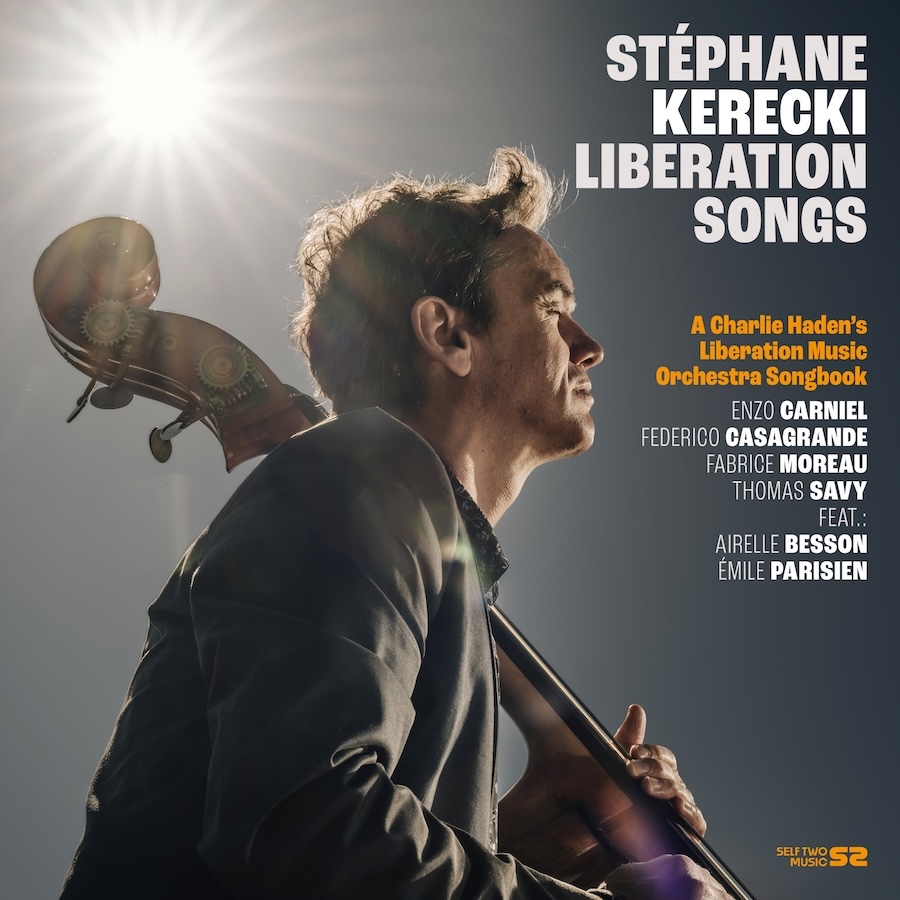
With his new album Liberation Songs, double bassist Stéphane Kerecki pays a nuanced tribute to Charlie Haden by reinterpreting his music.
An interview with Stéphane Kerecki by Franck Médioni.
Charlie Haden is one of the jazz musicians I’ve listened to the most — perhaps the artist who has influenced me the most. His beginnings as a singer are what first come to mind. I’ve always believed that’s why this bassist touched me so deeply, because singing was my first instrument at age eight. Haden, however, started singing at the age of two on his family’s radio show.
What mainly influenced me are his personal projects: first his duets with Kenny Barron, Hank Jones, or Pat Metheny, but also his Liberation Music Orchestra, with arrangements by Carla Bley, where he performed revolutionary songs from South America and the Spanish Civil War, surrounded by figures of free jazz such as Don Cherry, Gato Barbieri, Dewey Redman, and Paul Motian. This orchestra recorded few albums, but they were always conceived as reactions to political events — the Vietnam War, the fight for civil rights, the Gulf Wars — rooted in libertarian and committed music.
Haden’s sound is what I cherish most. Perhaps the most beautiful: warm, supple, rich in harmonics, both deep and warm in mid and high ranges, powerful yet never deafening, characterized by a necessary economy of means and always melodic. His musical quality is so widely appreciated probably because Charlie’s sound resembles that of a singer.
Liberation Songs
I wanted to surround myself with musicians with whom I share both musical and personal affinities. For me, it’s vital that these are musicians who know how to serve the collective. They are not the type to seek the spotlight but instead excel at blending into the moment, building music based on listening and silence.
I participated in Airelle Besson’s project Airès (with Édouard Ferlet), and I had the privilege of contributing to several symphonic projects she composed. As an anecdote, she also played several concerts with the Liberation Music Orchestra during their last tour, and she was praised by Charlie Haden and Carla Bley for her playing. Thomas Savy and I are very close: I participated in two albums under his name (Archipel and Archipel Bleu), and we have performed extensively in quintet and trio formats.
Émile Parisien is another artist with whom I share many musical memories, from working with Yaron Herman (Alter Ego) to my own projects (Nouvelle Vague and French Touch). He’s a unique saxophonist, and I appreciate his energy and kindness. Fabrice Moreau is a musical alter ego: besides being a talented drummer, he’s also an artist with a very personal vision.
Enzo Carniel and Federico Casagrande are two highly talented musicians from this new generation with whom I feel a strong affinity.
Regarding the repertoire, I initially chose hymns: We Shall Overcome, The People United Will Never Be Defeated, and Song of the United Front, which are very powerful melodies. As Haden said: “Most of the songs played by the LMO are beautiful because they were written by people fighting to live in a free society.” There are also three compositions by Haden dedicated to figures of resistance: Sandino, Song for Che, La Pasionaria, and a piece by Ornette Coleman: War Orphans. Finally, there are three pieces without an obvious political message: Spiritual, Silence, and Throughout.
All these pieces speak to spirituality. They address silence (Silence) and being true to oneself in the present moment. This brings in an inherent political dimension of jazz: our silences and spirituality are political in themselves because awareness requires a stance. This spirituality is a way to escape a condition. Whether it’s a specific theme, a character, or a guerrilla movement, these melodies serve as a framework within which thoughts can unfold: a declaration of love for jazz, its unifying power. Because collective music is what truly matters.
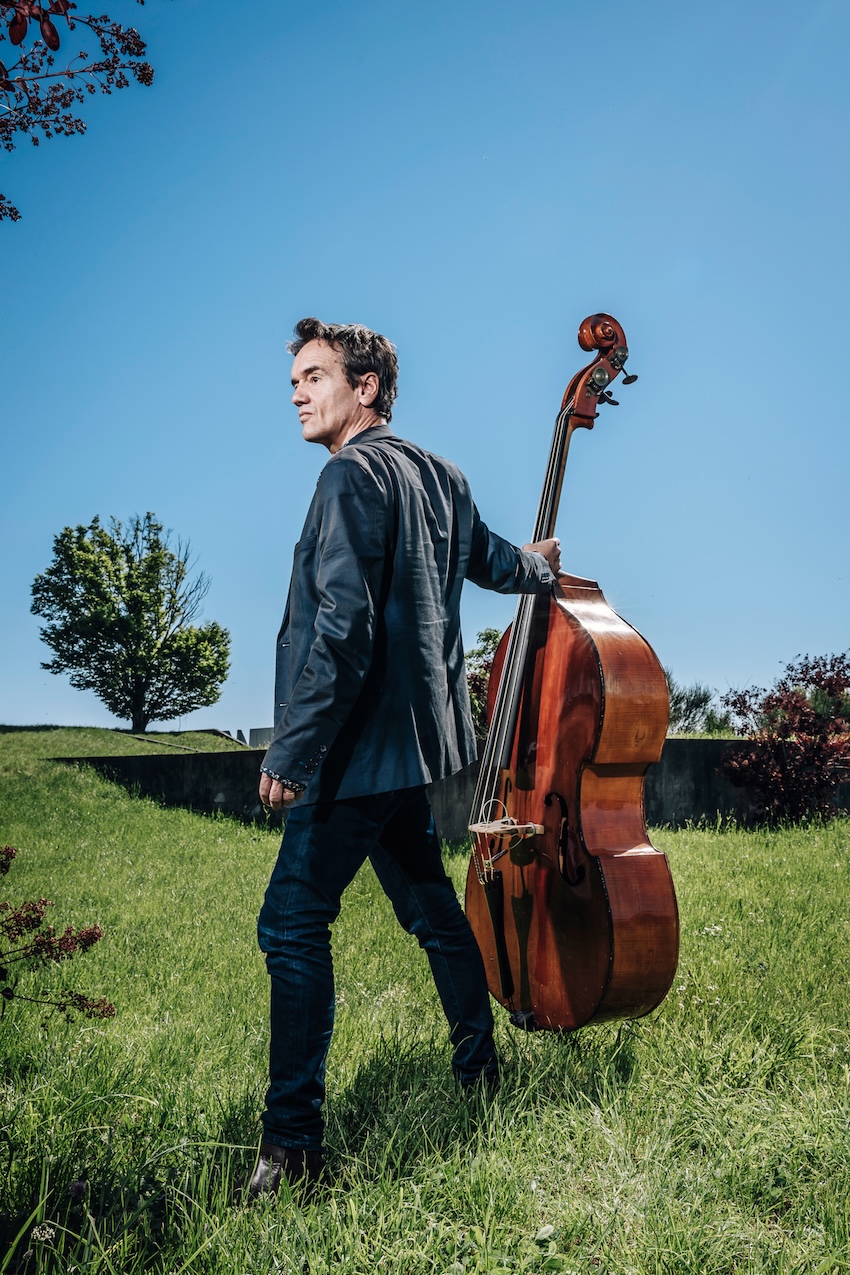
Stéphane Kerecki – Double bassist – Photographed for the “Liberation Songs” project in tribute to Charlie Haden – April 29, 2025 – Montreuil. ©Photo Eric Garault.
Resoance
In this band, everyone is equal, contributing according to what they wish to express, setting aside ego for the common good. It demonstrates that such a system works — at least in music. Today, many groups are led by a single conductor with musicians in service behind them. This resonates with our society, where listening has largely disappeared. This album embodies a utopia of freedom: recognizing the value of the other, engaging with alterity, and avoiding the need to constantly stand out.
Utopias
I am fortunate to belong to the last generation still confronted with ideologies and utopias aimed at building our society. I grew up in a time when it was possible to revere revolutionaries, even though we later saw that these utopias could lead to totalitarianism. Whatever mistakes they may have made or excesses that occurred, those driven by a utopia in search of the people’s happiness are more commendable than those who serve the oligarchy to which they themselves belong.
I also believe we have a duty to pass on this knowledge. We talk about figures that new generations do not know (perhaps except for Che Guevara, the most emblematic). It is important to realize that young people might not be familiar with these figures or references, even those of resistance. Because we live in an era that calls for courage. What’s happening in the United States, what fuels authoritarianism and fascism, is of course the fact that there are people advocating violence and potentially abusing the power they seize, but it is also cowardice. First and foremost, it is cowardice and compromise.
Talking about those who have stood firm, who have left slogans, calls to fight and courage, who have traversed through eras (“¡No pasarán!” — the antifascist rally cry of Dolores Ibárruri, the Pasionaria) is a universal act. Being antifascist is a humanist act. Respect can be given, even for certain battles, even if they are ultimately lost.
Today, we live in a world that is unraveling, disintegrating, having just crossed planetary boundaries. We find ourselves in a state of panic in the face of an uncontrolled collapse, with technology used for manipulation, beyond our understanding, depriving peoples of the ability to govern themselves. While our generation still lived in a relatively comprehensible, bipolar world with utopias we could choose from—utopias aimed at building a society with a desirable future.
This Liberation Songs album doesn’t necessarily aim to take a stance on specific events or issues, but I wanted to give it a humanist dimension: an invitation to reconnect with oneself and others, which is what gives meaning to our presence here. And this presence only has meaning within freedom and shared equality.
Rather than being merely committed, I feel summoned. How can I not react to what I see around me? So my approach is to draw inspiration from my elders, to return to what is my personal history. I think it was also important to share what these great figures of struggle have been — struggles fought not for themselves or their own power but for others, unlike all these figures that are now flourishing from Hungary to Brazil. I wanted this record to be an ode to freedom and consciousness.
Interview by Franck Médioni
Liberation Songs, a CD by Stéphane Kerecki (Self Two Music).
Liberation Songs will be released by the label Self Two Music, on November 14, 2025.
It will be distributed by Outhere Distribution.
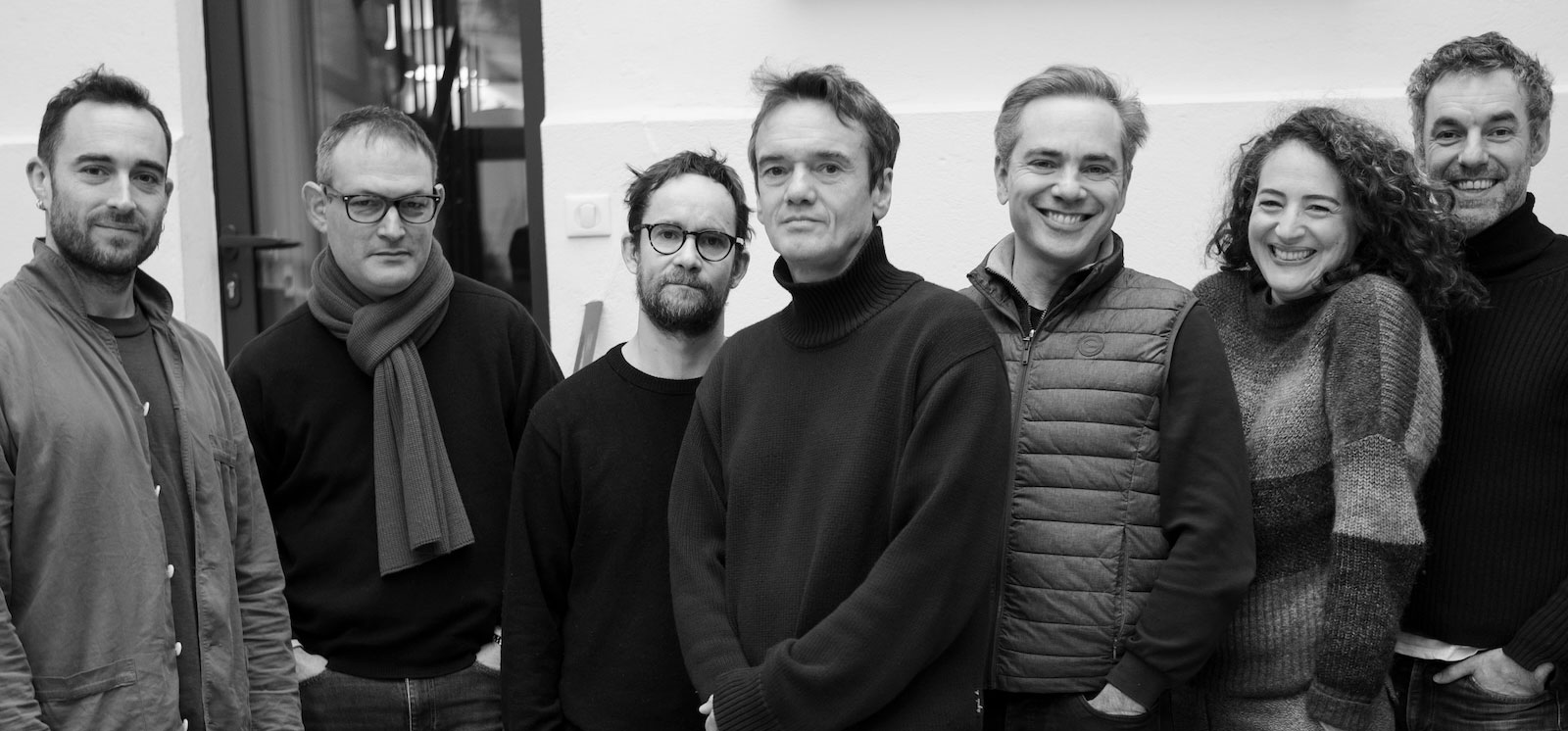
©Photo Header, Olivier Degen














RECENT COMMENTS