
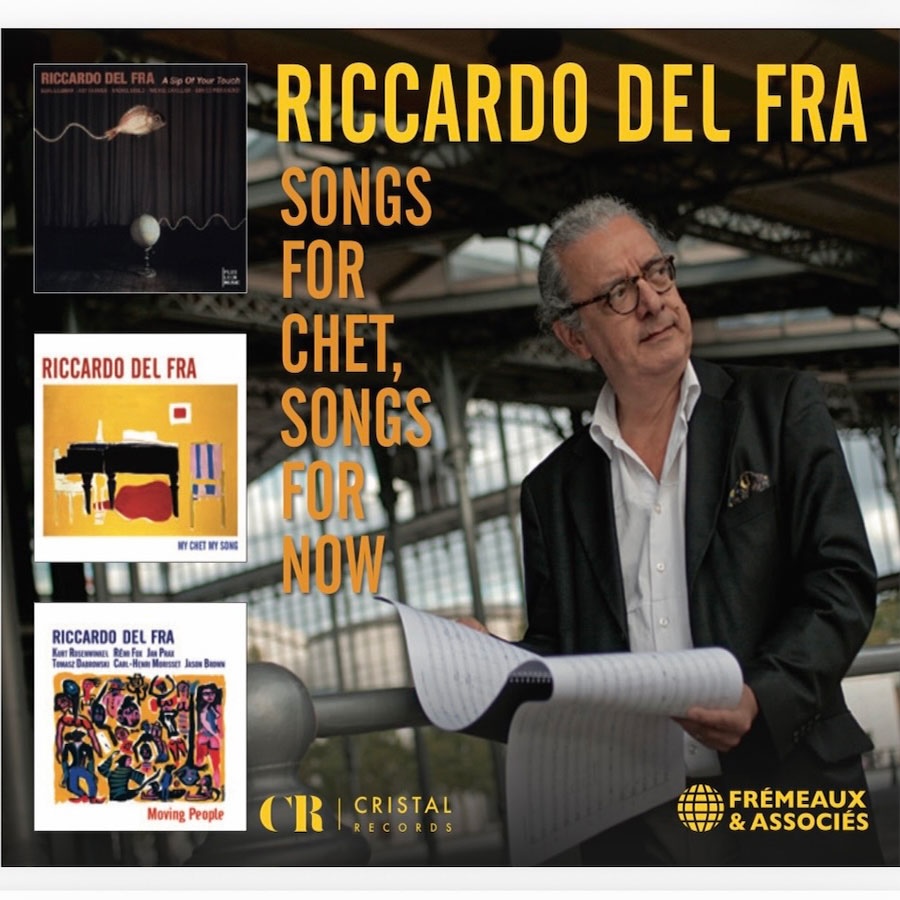

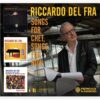
Meeting with double bassist Riccardo Del Fra, who has just released a three-disc box set, Songs for Chet, Songs for Now. In it, he pays a deeply sensitive tribute to Chet Baker, with whom he shared a long musical journey, while unfolding a rich sonic palette.
“My interest in melody must be genetic. My mother loved melody, she would cry listening to film scores. We know that our earliest influences happen when we are very young, and they leave indelible marks.
I actually started music very early, playing guitar, which I later swapped for electric bass before finally choosing the double bass at seventeen. I studied sociology and anthropology at the University of Rome while also pursuing musical studies at the Frosinone Conservatory, where Franco Petracchi and Franco Noto were my teachers.
I soon began playing with various Italian ensembles, notably those of pianist Enrico Pieranunzi, drummer Roberto Gatto, saxophonist Maurizio Gianmarco, trumpeter Oscar Valdambrini, and trombonist Dino Piana.
In Rome and elsewhere, I accompanied many jazz soloists: Art Farmer, Dizzy Gillespie, Art Blakey, Sonny Stitt, James Moody, Lee Konitz, Tommy Flanagan, Kai Winding, Clifford Jordan, Horace Parlan, Joe Diorio, Kenny Wheeler, Paul Motian, Dave Liebman, and many others.
Later on, I became the regular bassist in several groups, including those of Barney Wilen, Bob Brookmeyer, Johnny Griffin, Toots Thielemans, Michel Herr, and Charles Loos.”
Chet Baker
“I met Chet in 1979, in a club in Italy. He arrived late—as he often did, for many reasons. I will always remember the first tune we played together: ‘Stella by Starlight.’ A standard, everyone knows it, no problem… Then came ‘Airegin,’ in the original key—there, I had to do some serious gymnastics…
I’ll never forget it. I think I played quite a few wrong notes, but I must have managed somehow, because afterward he kept me for a recording session. At the end of that session, he asked me to join his band and follow him—which I did.
Gradually, my colleagues went back home, but I stayed. I dropped everything for him. What people may not know is that at the time I had a job, a family, and hadn’t finished the conservatory. I was nineteen, with plenty of work in Rome, playing with the RAI orchestra. I wasn’t a permanent member, but I likely would have become one—there were fewer and fewer double bassists, many had switched to electric bass. I had become something of a rarity.
I later dedicated my album A Sip of Your Touch (1989), a series of duos with Art Farmer, Dave Liebman, Enrico Pieranunzi, Rachel Gould, and Michel Graillier, to Chet, who passed away in May 1988.”
“The bassist is often a generous introvert”
“From seventeen to twenty-three, my role models were Paul Chambers and Ron Carter. Around the time I met Chet, I started listening to Scott LaFaro, Dave Holland, Jean-François Jenny-Clark, and Charlie Haden. More recently, I’ve listened a lot to Marc Johnson, with whom I feel a certain affinity.
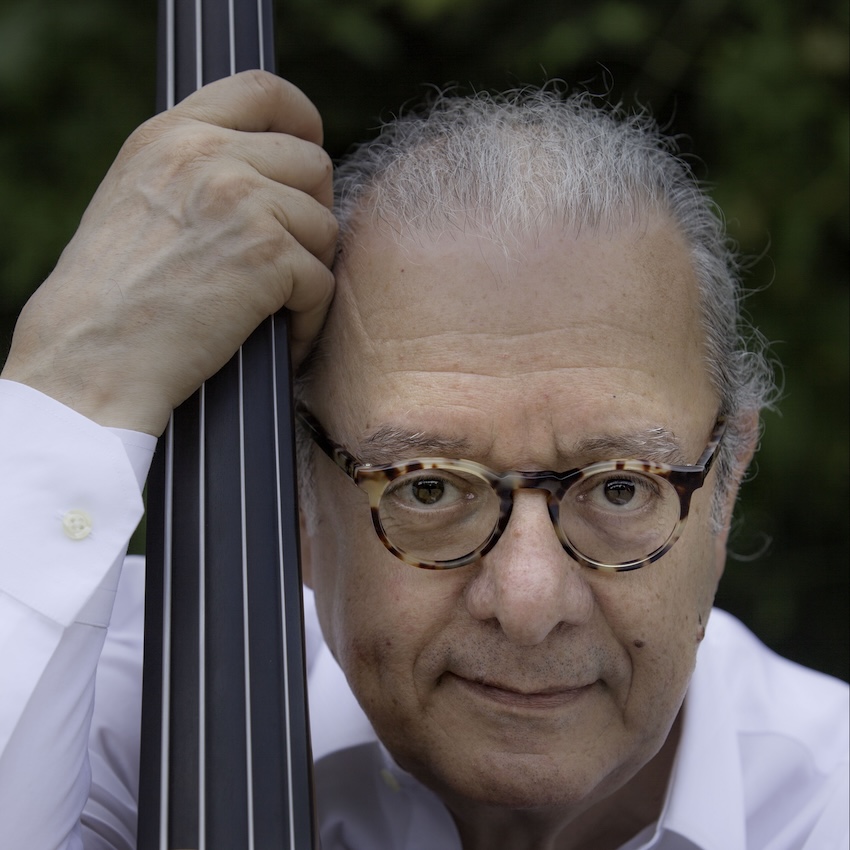 The bassist, I think, is often a generous introvert. In jazz—and even in classical music—his role is to serve harmony, melody, and the soloist, while also acting as a unifying force. Managing silence is part of music too—that’s a major lesson from Scott LaFaro and Bill Evans, but also from Miles Davis’ approach to group and solo dynamics.
Sometimes I feel like I’m singing through my double bass. When you achieve a beautiful solo, like Miles or Chet could, you see a shape, a gesture—it’s a delight. I don’t claim to reach that level, but when glimpses of it happen, it gives me great joy.
I favor this expressive side of the instrument rather than pure demonstration. My bass has a beautiful sound, especially in pizzicato, warm and almost vocal in the mid-range. It’s not perfect, of course—but with an instrument, it’s like a long relationship: you learn how it works, how it responds.
At some point, you have to let go of the idea of the perfect instrument and simply work with what you have. I remember discussing this with Mark Dresser—he felt exactly the same.
I believe I’ve often been called to work on film scores partly because of my instrument’s sound. Over time, with maturity, my tone has evolved—especially in controlling vibrato and achieving greater roundness. My bass lines have improved too, and my improvisation has gained depth alongside my development as a composer.”
Teaching
“In September 2004, I was appointed head of the Jazz and Improvised Music Department at the Paris Conservatory, succeeding Jean-François Jenny-Clark. It’s something I took very seriously.
My aim was to break down boundaries, to open windows and build bridges between jazz, classical, and contemporary music, as well as with other disciplines. I stepped down from this position in 2025.”
Moving People
“Moving People was born in Berlin in 2016, initially as a project commissioned to celebrate friendship between Germany, France, and Poland. We performed it in all three countries, then at the Italian Parliament for the anniversary of the Treaty of Rome.
Because of its success, I decided to record an album, expanding the group—originally German, Polish, and French musicians—by inviting American players and reconnecting with my Italian roots.
The central theme is socio-anthropological: exile, migration, war, but also empathy and hope. The titles speak for themselves: ‘Moving People,’ ‘The Sea Behind,’ ‘Children Walking (Through a Minefield),’ ‘Street Scenes’… Sadly, very current themes.”
Interview by Franck Médioni
Songs for Chet, Songs for now de Riccardo Del Fra by Les Éditions Frémeaux & Associés.
© Photos Roshanak







RECENT COMMENTS